I Think It Broke All of Our Hearts
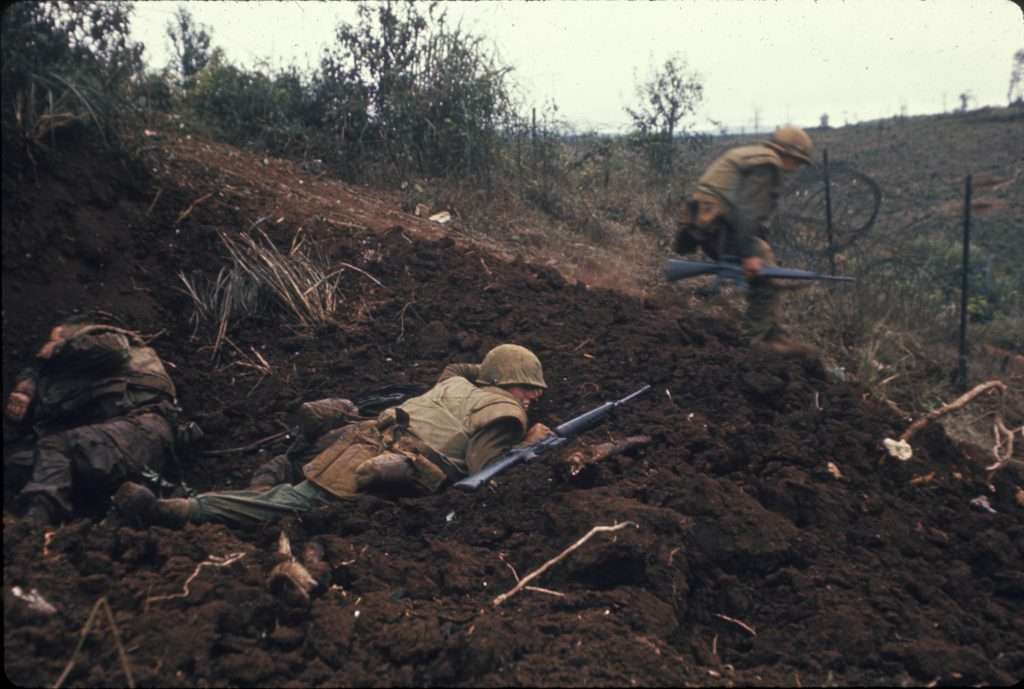
Vietnam War.
Credit: 1968 Robert Ellison/Black Star
This morning, and frankly, many mornings every week, month, and year over the past fifty-eight years, I think of what happened to my mates on this date in 1968.
I was there, in the close vicinity, I heard, I should have been out there, we weren’t allowed out there, we watched them return, we heard the stories, we listened, we whispered, we resented our leaders, we hated our enemy, we wanted revenge, we lived with it, we were guilty, we are guilty, we will always be guilty.
But whatever my recollections are of this anniversary of what has come to be called the Ghost Patrol, they are nothing compared to those who went outside the wire and walked—or were led by a young officer—into an ambush. A slaughter.
When we made the film, BRAVO! COMMON MEN, UNCOMMON VALOR, we talked during each individual interview about the date, the horror, the aftermath.
Here are some things the survivors had to say about that date. I have added some of their additional remarks that are not included in the film and have never before been heard.
Cal Bright
“I was on a patrol on February 25th. We were leaving at, I think it was like 0800, 0900, something like that. And I ended up being point for a while, and my team member, a Clayton Therrell, who was from Racine, Wisconsin, was directly behind me and we got out so far and he motioned for me to stop. He says, ‘I’m going to take your place,’ he says, ‘This is your first patrol and consequently we just want to be safe.’ I said, ‘Okay, fine,’ and probably within five minutes, all hell broke loose from the back portion of our patrol, and I find out afterwards two or three NVA jumped and suckered part of our platoon into following…chasing them, which they definitely did and that’s when the ambush was really sprung.
“And when I finally hit the ground, I could tell that Therrell was killed. My team leader who was Lance Corporal Thrasher from Oklahoma City, asked me to go up and retrieve the body, or bring him back, he might still be alive. I kind of knew differently, but, okay I would. So I stripped down and went up and grabbed ahold of his flak jacket by the collar and as I was dragging him back, the body was bouncing, jumping back and forth and I could feel bullets whizzing past my head, to my sides, and so in a sense, his body protected mine and I look back and for a long time, in fact I still do it every once in a while, that it should be me instead of him, but I guess the good Lord upstairs had something more in mind for me. “
John “Doc” Cicala
“That’s a tough one. I relive that thing quite a bit. I remember us saddling up and going out the gate. We had a Chu Hoi scout with us and we were supposed to follow a designated route, bracketed on all sides by artillery within an instant. Well, we got about five hundred meters, I guess, outside the gate, crossing the road, and Lieutenant Jacques spotted a couple of North Vietnamese standing over in a field, and he made a decision, we’re going to take ’em prisoner. And I do remember the Chu Hoi telling him no, and a lot of us saying maybe we shouldn’t do this, but he gave the order, so we went to get ’em. And, I guess probably a few hundred yards further out, we crossed the road, we crossed a set of trench lines and then they opened up on us and it was just pure chaos from there on.”
Ben Long
“I helped plan that patrol. We had made the checkpoints. I knew how far they were going out, and from my perspective I thought this patrol should have no problems; there should be nothing to be concerned about. So, I remember watching them go out the wire. You couldn’t see them for very long because it was very foggy. And they soon disappeared and I went back in the bunker. I remember listening on the radio—they were checking in and what they were doin—and then I got busy because the next thing I realized was that they had contact, and I didn’t realize—wow, they’re in contact. How did this happen? Because I thought, no way they’re going to be in contact when they follow the route that we had prepared for them. So I thought, either in the fog they got lost, or didn’t know where they were, or they were well beyond the checkpoints…it shouldn’t have happened that way.
Company Commander Ken Pipes
“There’s been a lot of things written about that, some of it not good, some of it an attempt to be factual. But it was something that was not uncommon in Vietnam at the fire team, squad, platoon level, and in some instances entire battalions, entire companies.”
Peter Weiss
“I was the backup for Don Jacques, and so when he went out, my platoon—two of the squads—we were the backup. So we were on the radio listening to what happened and when he was ambushed, Captain Pipes came on the radio. ‘Okay, Lieutenant, it’s your time to go out.’ And two squads—we actually split up—one squad and I went straight out towards where they were. The other squad went to the right, which was up toward the road, because the sergeant I was with had been out there before…had been there for a while, and he knew the terrain. I didn’t know what was out there. I’d never been outside the perimeter other than being on the hill. And unfortunately, he got trapped in the same kind of ambush, and so of that squad—maybe of ten men, I think—four were killed in that ambush.”
Steve Wiese
“It took me thirty-five years before I could get into my mind that we went out there at nine or nine-thirty, whatever it was, ten in the morning, and I didn’t make it back into the base until the sun was going down, and used darkness as a cover to work my way back.
“But the initial ambush, once they opened up, I mean it was bad. I mean they opened up and you know most of the guys went down in the first minute. I mean, it was not a good thing. The actual battle itself at that point went on for hours. The only reason I survived was I just happened to be standing in a bomb crater where it was like 2-1/2 feet deep where it blew the ground out, and I just happened to be walking through that at the time that the ambush opened up. And when the first round went off, I dropped and just…my luck was that I just dropped in that hole. So I was below ground level when all the—you know—all the bullets and everything were going over. And I just laid low.”
Cal Bright
“I come across a radio operator who had been killed—to this day I have no clue who, what his name was. And all I could hear on the radio was, ‘Hello, hello, anybody there, anybody hear us?’ And I never had any training whatsoever as far as talking on the radio. I had none whatsoever. But I knew, press the mic. So I keyed the mic and said, ‘Hello.’ And somebody come back and said, ‘Who’s this?’ and I said, ‘Well, this is Cal.’
“‘Cal who?’ And I told him. He said, ‘Who else is there with you?’ I called back and I said, ‘Nobody.’ He said, “What do you mean? I said, ‘There ain’t nobody here alive; they’re all dead.’ And he said, ‘Where are you at?’ and I says, ‘I’m laying next to a road and I’m overlooking another road that goes down over a hill.’’ And he said, ‘How did you get there?’ I said, ‘This is where we ended up.’ He said, ‘What can you see, from where you are…laying down?’ I could see little helmets in the background.
“Unbeknownst to me at the time, I was just a few meters away from the NVA trench line. I had no clue I was even there, that close to them, and somebody else come on the radio and says, ‘I want to shoot a round.’ He says, ‘I want you to let me know where they land.’ I say, ‘Okay.’
“Next thing, out comes a round—afterwards I found out that it was a Willie Pete round. It was a spotter round, and I went back to him and I said, ‘You need to drop the range down,’ and he says, ‘How much?’ I said, ‘50 yards, 75 yards,’ something, and he dropped it. Shot another round. I says, ‘You need to drop it another 40 yards,’ he said, ‘Okay.’ He says, ‘Bury your head, because we’re going to fire for effect.’ And that was the last I heard, because all of a sudden, bah bah bah boom boom boom, rounds were going off left and right.”
John “Doc” Cicala
“I just watched a guy drop and I took care of a couple of guys and then I was crossing back over the road because another guy got hit, then the next thing I know I seen a guy pop out of a fighting hole. He hit me a couple of times in the chest. I was laying there and the other Corpsman, Frank Calzia, seen me go down and he come running over yelling at me, ‘JC, are you okay, are you okay?’
“And then a grenade landed between my legs and I looked down and I seen it and I yelled ‘Grenade,’ and he hit the dirt and I curled up into a ball and it went off and I couldn’t hear or see anything for a minute with all the dirt and everything and then when I could see, my foot over there and I’m thinking to myself, this isn’t good. My foot moved and I said, ‘Well, at least it’s still attached,’ and by that time Frank came over and he said, ‘You know, we got to get out of here,’ and I told him, ‘Git, you know, go take care of that guy, I’m okay, I’ll take care of myself.’
“And then Lieutenant Jacques came running by and he looked down at me and he said, ‘Doc,’ he said, ‘Get out of here.’ He said, ‘We’re all getting killed.’ And he made it from about here to the wall and I seen him go down and I crawled over to him and he’d caught it right across the legs, both his femoral arteries, and by the time I got to him he’d already bled to death and there was nothing I could do for him.
Ben Long
“In all the confusion that’s going on, men were getting shot and you could hear that happening and I moved from my bunker. I moved up on top because I not only wanted to listen, but I wanted to see if I could see them, and it was too foggy and I still couldn’t see, but I still stayed outside because I thought maybe I’ll be able to see something. Maybe the fog will float by and I’ll be able to get a glimpse, but really, it was very foggy that day and you couldn’t see hardly anything.
“First Platoon was called up and they were the ones who were supposed to go if it got into trouble and I thought, they’re not going to get in trouble, no problem. I was Platoon Commander for that platoon for 8 or 9 months, for a long time. Those were my buddies. They were my friends. I knew them. And I thought, if they’re going to go out, I want to be their leader. I want to take them out. I know how they work together.
“And so it was hard for me to not be with them. I knew that some of my friends were being shot, some I knew were dying. I heard it on the radio. But it would just tear your heart out. These were guys that I had been working with for a long time. I felt helpless. I felt so powerless. There was just nothing I could do. I mean, I wanted to do something. I think everyone in the company wanted to go out. We wanted to do something, but we got orders: no, no more people, we can’t do that, can’t go out.”
Peter Weiss
“Then we got the word, come back, retreat, and I remember very well, because we were laying out in the open because we got stopped at some point; rockets started coming in.
“I was right next to someone who I believe was killed because I checked his pulse. My weapon had stopped firing. Couldn’t use it. Just me and the body and I wasn’t sure if I should drag him back. And bullets started coming…being walked toward the two of us. And the last one stopped right at the fellow, right in his chest—must have been a fifty caliber hit him, and I said, ‘He’s got to be dead.’”
Steve Wiese
“You know, the initial blast started quieting down, and then you could tell they were just firing pretty randomly and if anybody moved, they just drew fire. So I just laid there and threw grenades. Shot a clip of ammo out of my rifle which basically I figured out pretty quickly, that was not a smart thing to do. Because as soon as I fired a round there were hundreds of guys shooting back. So, it was like okay, don’t draw attention to yourself.”
Cal Bright
“I was able to get out of there after some time. How long? I have no clue. It was still daylight but I could tell that the sun was—what there was of it—was going down so I figured it had to be late afternoon, early evening.
“I knew where our lines were at, and I was able to evade some enemy soldiers, and I was able to get back, and then, as I was coming back, all of a sudden, here’s these—I didn’t recognize as to who they were until I got closer—South Vietnamese ARVN Rangers. And they were waving at me to stop. And then I could see some American advisors telling me to stop, halt, don’t move. Don’t move, whatever, but I kept coming. And that was when I tripped over barb wire that also had a red triangle-shaped sign on it. Come to find out afterwards, I went through the entire mine field in front of Khe Sanh and never touched a round off. Now I know why they kept telling me to stop and not to move.
“Again, I’ve never been real religious, or anything whatsoever, but I have to think that the Man Upstairs had something in his…on his agenda. Says, ‘I want to talk to you, young man.’
“I know there has been conflicting reports as far as how many of us went out. I was led to believe there was like anywhere from 60 to 70 of us that went out and there was only just a small handful of us that come back.”
John “Doc” Cicala
“They said I made it back to the base, maybe six, eight hours later. But I did see a lot of guys go down. I seen Clay go down, I seen Jerry Lee Dotson. I took care of them. There’s nothing you could do, it was just chaos for that five or six…probably five minutes or whatever it was. I mean I heard all the stories afterwards. We ran into a battalion-sized force and everything, but it didn’t last long and it wasn’t pretty. That’s for sure.
“I crawled back to the base. I was kind of passing in and out, you know. I don’t remember all the details and I was pretty well messed up myself, but I do remember setting off a trip flare and when that went off I was thinking, ‘Oh, shit,’ but one of the weapons platoon guys—a guy named Eddie Pendergast—had a set of binoculars and he looked out and seen my uniform and he said, ‘Stop, cease fire, that’s a Marine coming in,’ and he physically ran out, him and a couple other guys, and they threw a poncho over the wire, grabbed me and yanked me back over the wire. Took me to Charlie Med.”
Ben Long
“I just started seeing people coming back, not in groups, but straggling back and some were wounded. Some were very severely wounded, and it was just very hard to take, but from my perspective, also what I saw was just a sense of confusion, a sense of ‘what’s going on…what’s happening?’ And it’s like how come we’re not doing anything? How come we’re just standing there? How come we’re not going out?
“We always want to rescue our people and we don’t want to leave our dead and wounded. Nobody was doing anything, and it was hard. Hard to watch that. We wanted to do something, but at the same time, we just couldn’t. So we had to be patient and wait and that was hard, that was really hard.”
Company Commander Ken Pipes
“But that one, that one was the hardest, I think. I think it broke all of our hearts.”
Peter Weiss
“We came back, maybe about three or four of us left, and we then came back into the perimeter. And a couple hours later, we were shelling that area. Planes were coming over dropping bombs, and all of a sudden, out on the outskirts of the wire, a lone Marine came. He was not in my platoon. And then I went out to get him. Walked through that minefield, not, you know, around the side, but through the minefield. And I was scared. Walked through the minefield, walked through the concertina, and he was in absolute shock. Grabbed him by the arm and we walked back through the minefield, back into the perimeter. I was happy that I got him out of there and that we both got back. That was a sad day.”
Steve Wiese
“I ended up leaving my rifle and just trying to work my way through. I had a pistol and I was using that for personal protection because the rifle was useless at that point, and it was just something to carry. I would dive from one bomb hole to another. Work behind anything I could find that was any kind of cover.
“I would lay there for fifteen, twenty, thirty minutes. So, in between the firing, when it started to settle down a little bit, I would try to, you know, peek above and see, try to see where I could get to. And it took several hours, you know, of working my way across and moving out of the kill zone.
“Sometimes I’d have to lay there for two hours and wait for the firing to slow down. Towards sundown, in the shadows, I could move better and I worked my way out and moved down around the back and came back to the base.
“Several people came in through the gate, you know, and it was just like, where is everybody? I just remember the guys saying, ‘You’re pretty much it.’ When I got back to my squad area, Author Smith was in the bunker, and he said he was it.”
To reiterate what Skipper Ken Pipes said: It broke all of our hearts.
They are still broken.
~ By Ken Rodgers
To learn more about each of the men in this blog, click here.
_______________________________
Thank you for reading, and for honoring all Vietnam War veterans by sharing this blog, our films, and stories with friends and other veterans.
BRAVO! Common Men, Uncommon Valor can be viewed on Amazon Prime. We also have DVDs available, which can be ordered on our website at https://bravotheproject.com.
You can find information about our companion film featuring eleven courageous spouses of combat veterans from various eras at https://imarriedthewar.com. I Married the War can be viewed on Amazon. DVDs are also available via the website.


