Bravo! The Project - A Documentary Film

Posts Tagged ‘Echo Company’

Other Musings

February 10, 2026

Boocoo

Tags: , , , , , , , , , , , , , , , , , , , , , , ,

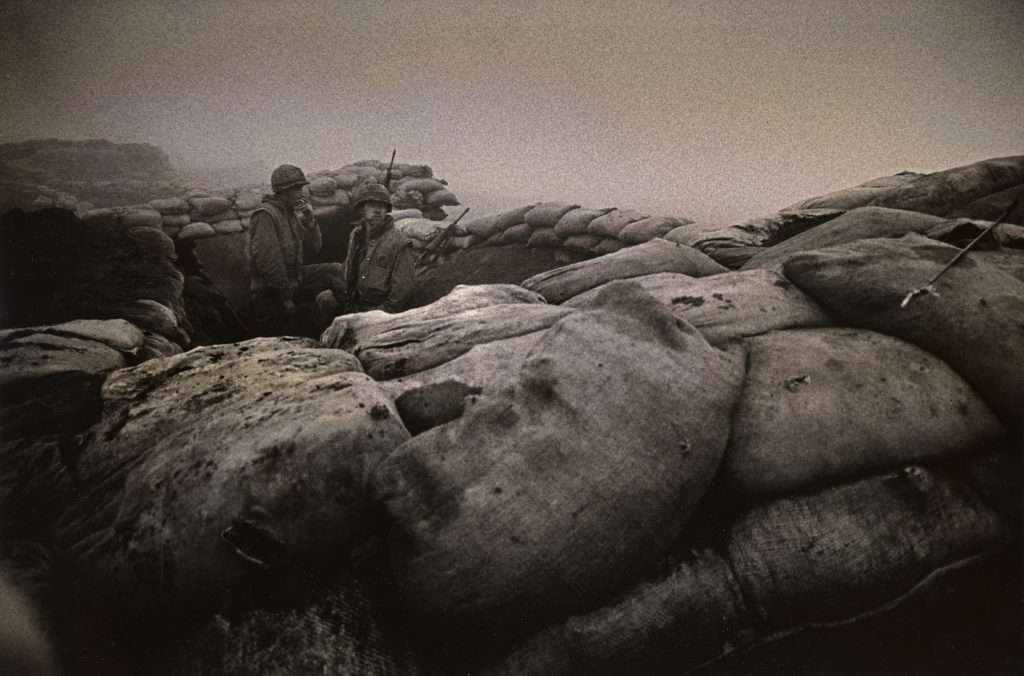
Photo courtesy of David Douglas Duncan

In my most recent entry to this blog, I talked about my inability, even after the horror of January 21, 1968’s attack on Khe Sanh, to believe that it was more than a one-off attempt by the NVA to catch us weak or asleep.

By mid-February, I’d been disabused of that notion and as the month rolled forward, my acceptance that things would not get better but would only get worse drummed me like a dead rat stomped into the red mud at the bottom of the trench.

On February 5, 1968, NVA troops briefly overran much of Hill 861-A just west of the combat base which was occupied by Echo Company, Second Battalion, 26th Marines. Echo engaged in up-close-and-personal combat before they drove the enemy off the hill.

On February 7, the NVA overran the Special Forces compound at Lang Vei and used tanks in their assault. PT-76 tanks. Not something we’d worried about in our daily trench digging. We imagined that night and into the early morning, enemy attacks with armored vehicles crashing through the wire and wondered how we could possibly fight that. We thought we heard them out there. All night long.

The next day, a platoon from Alpha Company, First Battalion, 9th Marines, was attacked on Hill 64 not far outside the perimeter of the combat base. A nasty, vicious firefight ensued with heavy casualties on both sides. In our trench, we waited, biting fingernails, writing letters home to moms and girlfriends and wives. Gloomy letters, angry letters, defiant letters. Maybe, as we wrote on our stained sheets of paper, wings of hope tried to lift us up so when the moment came that we needed to fight for our lives, we would own the spirit to become ferocious.

On February 10, 1968, the men of 3rd Squad, 2nd Platoon, Bravo Company, First Battalion 26th Marines, were filling sandbags when a C-130 designated BASKETBALL 813, flew in from the east and was hit by enemy anti-aircraft fire. The plane circled around the base and came in from the west. We watched, nobody talking, as the obviously wounded flight managed to get onto the runway before it skidded off. The plane burned and smoke and flames erupted from the fuselage. We were not more than one-hundred yards from the event. We watched as men jumped out of the cockpit. By then, the horrors of war were old hat. We were numb, and this and subsequent events would numb us more.

Later in the month, Bravo, 1/26 suffered a blow on the 25th in which the NVA first ambushed a patrol and then a relief patrol that went out as reinforcement. The losses were devastating for the men of the company. I will have more to say about this at a later date.

The amount of incoming artillery—rocket and mortar rounds—also increased, often pinning us in the trench for what seemed like hours as the ordnance rocked the ground. We heard a lot of the NVA artillery leave the tube and the big ones, the 152-millimeter rounds, sounded like trains as they approached. Men died, men were wounded, men almost broke. We discovered one of our staff sergeants whining like a beaten dog as he dug into the bottom of the trench.

But maybe what saved us from going completely nuts were a few events that led to chuckles. Sometimes it was morbid stuff, but those who have been through hell often understand the warped humor humans can dig into when circumstances necessitate.

I don’t remember exactly when these following three things happened, specifically, but I’m pretty sure they all occurred before the 20th of February.

Early into the siege, the 37th RVN Ranger Battalion, our allies, arrived at Khe Sanh and dug in on a line in front of some of 1/26’s entrenchments.

One evening, just before sundown, I was ordered to report to the platoon commander’s bunker. It was our squad’s turn to conduct an LP (listening post) for the platoon, and it was my fire team’s turn to stand that particularly distasteful duty.

We all hated LPs. Four Marines out in the dark, trying to stay alert, trying to stay alive, knowing that if the enemy approaches, it’s the LP’s duty to alert the base and in doing so has an almost 100 percent chance of being discovered and killed.

We hated everything about it. Leeches, and rain and mud, and dark, dark, nothing to see beyond the reach of your arm. Trying like hell to stay awake.

But it was our turn, so when the platoon commander told me we would be running the LP with a team of RVN Rangers, I wasn’t happy; but who cared besides me? I was ordered to lead the other seven members of the listening post out to the end of the air strip where two slit trenches awaited our stay for the night.

The Rangers didn’t speak English, or if they did, none of them volunteered to talk to us and none of the Marines knew Vietnamese beyond Dien Cai Dao which we bastardized to Dinky Dao, and the French word Beaucoup to Boocoo.

But just before dusk died, we arrived and set up in the two trenches. The whole scene seemed menacing to me: two teams, can’t talk, different cultures, dark coming, North Vietnamese out there creeping around, maybe just beyond our position. A wall of tall jungle grass stood close to our front. I remember thinking that if the enemy came at us, we wouldn’t see any of them before they burst out within a few feet of where we sat.

I assumed my Vietnamese colleagues were whispering the same thing that I told my team, to keep an eye on that wall, to keep ears open, keep eyes moving, because when one stares at things directly in the dark, the immovable moves.

I felt lucky because all the men in the team, my American team anyway, had been in-country for at least three months and had been on a lot of night patrols, ambushes, and LPs.

One of the things about being a low-ranking grunt is that you never get enough sleep, so when we went out on LPs, even though the upper echelon expected us all to stay awake all night, we took turns watching and operating the radio which we employed on a regular basis to report that the situation was all secure.

Dark slammed down and we watched. I noticed all the Rangers sat ramrod straight, wide awake. I imagine now, their eyes big as half dollars.

When dawn broke and a weak morning light hinted at rising, I woke the team and looked at the Rangers. They glared at us Jarheads, and one of them took his right index finger and made a sign as if cutting a throat. I remember thinking that no one was dead, so no harm done, no worries. And we got some sleep, even if it was fitful and edgy with the lurking threats.

I called into the platoon radio operator and told him we were coming in. We made sure the four Marines were in front. The Vietnamese Rangers came in the rear so that no Marine mistook them for NVA sneaking in.

Sometime later, I am not sure how long, a few days, a week—sometimes I wish I’d kept a diary—the Rangers and the NVA got into a firefight out beyond the perimeter of the base. I think it was an attempt to stop the NVA from shooting a recoilless rifle into our lines. The Ranger unit’s officer was killed.

They sent our platoon, or part of it, out as security or backup or relief for the ARVN Rangers. We went out and into a bamboo thicket so dense you had trouble seeing the men on either side. We were ordered to dig in but I do not think any of us dug in. We sat down on the ground and in anticipation of battle, we looked at bamboo. Bamboo to the front of us, to the side of us, to the back of us. Thick and stifling and dreary.

Gunfire and screaming rose from the unseeable front and we waited, the moments like hours. Then on a trail nearby, we heard chatter and laughter and soon a group of men appeared that we could see as they got close to our positions. They giggled and I wondered if it was from the relief of still being alive after tons of fear released itself and they retreated. When they passed, I saw they were our allies. They carried a body, and then more men appeared toting a recoilless rifle, either a 57mm or 81mm.

After they passed us, we returned to our positions.

Later, when the sun went down, another Marine and I were called up to the platoon command post. When we arrived, two ARVN Rangers waited in the trench with a covered body on a stretcher. It was the ARVN Ranger officer killed earlier that day.

The lieutenant told me to escort them up to Graves Registration—the morgue—so that some Marine on watch back at rear echelon units didn’t kill them because they looked like the NVA.

It was an overcast night which I think was a boon to us; no light to expose us to the enemy.

I led the other Marine along with the two Vietnamese carrying the stretcher and reported to Graves Registration. Either a corporal or sergeant began to write out paperwork. Right then, the sound of footsteps running came from a hall. I looked around, nervous, wondering why someone would be running. Another Marine burst out of that hall and ran across the room, his arms up like a wide receiver in a football game, and right behind, a foot, all by itself, came flying out. He caught it like he was on his way to a touchdown. Something dropped. I looked. The two Rangers were gone. The stretcher lay on the ground, the body as unaware as any dead man. I laughed at the situation. Maybe I was sick, but I laughed as did my mate and the Marines working there, some of them morbidly dulled after dealing with a deluge of body parts, blood, and dead men.

Outside, I found the two Rangers squatting in the trench. The light leaking from the mouth of the hatch lit their eyes, which were glazed in fear. Maybe they were worried that whoever used to own that foot would be haunting the place and the men who worked there, forever. We, the Americans, thought the Vietnamese feared the spirits of the dead. Most of my comrades and I did not believe spirits of our dead hung around after the end, or that the spirits even cared.

The month ticked on. One catastrophe to another, one day to night, to day. Death and fear lurking in the shadows.  Maybe those were the spirits we needed to fear.

One of the irritating things about the Siege was the lack of chow. C-rations were our mainstay and over time we adopted our favorites. Pound cake, canned peaches, chicken noodle soup, and beans with franks are some I remember as being palatable.

During the month of February, chow, like mail from home, got scarce, we went down to two meals a day, and on certain days, even less.

So, when the platoon commander ordered me to take a procurement patrol up to the supply dump, I was  more than ready. During combat, in the Marine Corps, you don’t steal what you need, you procure.

The dark night hung on us like a cape. We worked our way between our behind-the-line units so as not to draw attention.

We came at the dump from the back. There was a wire fence. We defeated that obstacle. Inside, large pallets of stacked goods covered with tarps were arranged in neat and tidy rows. We had to search beneath the tarps for food.

Finally, we located a pile of stacked cases of C-rations and started gathering a couple of cases per man. There were seven or eight of us. We got canned fruit, and grapefruit juice, too.

We eased back to the fence and just before exiting the supply dump, someone demanded, “Who’s there?”

Everyone froze. A Marine came out of the dark with the business end of an M-16 pointed at us.

None of my people wanted a confrontation. We certainly didn’t want to get shot in our own supply dump after surviving the hellacious incoming we’d been experiencing.

I gave him the password.

He looked at the cases of food and told us to drop them.

I asked him his plans.

He said, “Turn your asses in.”

I said, “Man, we need chow and we were ordered to come down here and procure some food.”

“Who gave that order?”

I didn’t want to incriminate the platoon commander, the platoon sergeant, or anyone else.

One of the other Marines got into a conversation with the guard about his home, his accent; maybe they were from the same locale. I do not recall.

The conversation veered to how long he’d been in-country. He said, “Outta here tomorrow.”

I said, “Man, you are so short. Why don’t you just let us go?”

He shook his head and frowned.

Someone managed to dig up some MPC (military payment certificates) and flashed them in the guy’s face. He looked at the money, he looked at us, he looked at the rations.

He took the money.

We delivered our bounty to the command post and the lieutenant told us to return to our squad area.

We went back, disappointed because we had nothing.

Later, the platoon right guide came around and dropped off a couple of cases of C-rations. No fruit, no juice.

The rations were so old, from the time of the Korean War in the ‘50s, it was hard for us to eat them. But we did.

And we survived, most of us, to live a few more minutes, a few more days, maybe all the way until we again stood inside the good old USA.

~ By Ken Rodgers

_______________________________

Thank you for reading, and for honoring all Vietnam War veterans by sharing our films and stories with friends and other veterans. 

BRAVO! Common Men, Uncommon Valor can be viewed on Amazon Prime. We also have DVDs available, which can be ordered on our website at https://bravotheproject.com.

You can find information about our companion film featuring eleven courageous spouses of combat veterans from various eras at https://imarriedthewar.com. I Married the War can be viewed on Amazon. DVDs are also available via the website.

Other Musings

February 4, 2025

A Terrible February

Tags: , , , , , , , , , , ,

C-130 burning at Khe Sanh Combat Base. Photo courtesy of David Douglas Duncan

By Ken Rodgers

I suspect that everyone who sees combat has terrible times, terrible days, or years. For me, at the Siege of Khe Sanh, the month of February stands out. Not only did the heavy incoming arrive on an almost daily basis, but combat on the ground, and in the air, took on a furious character.

When we weren’t in the middle of it, we had ringside seats, and the evil stink of rumor crept among us, a whisper that added angst to every bite of the spare supply of C-rations we crammed into our mouths.

Some of my salient memories follow.

On the early morning of the fifth, the enemy assaulted Hill 861-A, manned by Echo Company, Second Battalion, 26th Marines. The NVA came through the perimeter wire and were on the hill. A vicious fight ensued, and the enemy finally withdrew. While this was going on, NVA mortars and artillery pounded the combat base below, to silence our guns that would help defend 861-A.

On the night of February 7, the NVA assaulted the Special Forces camp at Lang Vei, not far from Khe Sanh Combat Base. Using tanks, they broke through the defenses and the camp fell after a nasty fight. During the middle of the night, we got word that enemy tanks were in the area. Tanks. I remember thinking I heard the squeak and crank of tank tracks out in the night. Mostly my imagination, I suspect. We were taking heavy incoming fire to create more chaos, so all the noise added to our anticipation. Dark, and death, and fear, and a horrendous racket.

In our area, our squad leaders told us to saddle up in anticipation of relieving Lang Vei, but we never left the combat base. I think there is still, after fifty-seven years, some residual anger from the men who survived the fight at Lang Vei, as well as some residual guilt among the Marines who didn’t come out to save them. I recall, about ten years ago, hearing an audio clip from the commanding officer of the Third Marine Division, explaining in graphic and direct terms why he refused to go out and save the camp and the men who didn’t get out.

Continuing salvos of incoming killed men on the surrounding hills and men in the trenches and men in their bunkers. A plane was lost south of Lang Vei while bombing enemy tanks.

Alpha Company, First Battalion, Ninth Marines, had a platoon stationed on a location known as Hill 64. On February 8, the NVA, led by a bugle call, assaulted Hill 64 and an hours-long firefight went on. With the enemy in their trenches, the Marines of Alpha fought. Eventually a relief column from the company managed to fight its way onto Hill 64 as the enemy was driven off. To those Marines who fought on the hill, the subsequent call to abandon must have been a bitter pill.

On February 10, an incoming C-130, callsign Basketball 813, approached Khe Sanh, but at the last moment veered off the runway approach and flew low around the south side of the base and came in from the west. It was obvious to us, standing there on the ground watching, that something was wrong, maybe mechanical, maybe a wounded bird from the NVA flak constantly flying into the air. The plane came in hard and fast and veered off the runway and wrecked close to our lines. It ignited and men came dropping from the windows of the cockpit as the plane burned.

On 23 February, 1968, the NVA sent at least 1,307 rounds of incoming into the base. Mortars, rockets, artillery. Some of them big guns—152mm howitzers—and you learned to recognize the sound of the round leaving the tube—thump—and then you knew it was already in the air and on its way. They sounded like freight trains. If you survived long enough, you knew the fear they threw at you along with the hot metal and shrapnel that tore flesh and cut off legs and arms, and you learned the details of the thump and if the thump spoke in a very particular vernacular, you knew that where you lay in the trench would soon erupt. Despite the hell and mayhem and death, you got up and moved.

We received lots of new guys during the month of February. When the 152s fired, I would yell, “Move, a round is on its way,” and many times the men gawked, mouths open, their fear refusing to let them crawl to a different place in the trench.

On 25 February, besides a debacle I will write about soon, NVA trenches were detected within 25 meters of our perimeter. If we didn’t feel surrounded before, we did then. Marines with stethoscopes listened to the sounds of the enemy digging their trenches. We imagined tunnels beneath us, mined with tons of explosives to erupt and kill us all.

On February 28, The NVA launched a massive assault on the ARVN troops sharing the line with us. The din of combat sailed over the ground into our ears. Our bombers and artillery units pounded the attackers and the ARVNs bravely fought them off more than once, their courage under fire in stark contrast to so many of the disparaging rumors we had heard concerning ARVN troops. In this case, they didn’t disappoint us.

_________________

Thank you for reading and sharing our story with friends and other veterans.

You can find information about our companion film featuring eleven spouses of combat veterans at https://imarriedthewar.com.

Documentary Film,Khe Sanh,Marines,Veterans,Vietnam War

February 9, 2018

9 February 1968—Fifty Years Ago Today

Tags: , , , , , , , , , , , , , , , , , , ,

Early in the sequence of events that make up this blog, I sat on top of a bunker with a Marine as he fired a fifty-caliber machine gun at anything that moved outside the concertina wire. F-4 Phantoms, F-8 Crusaders and A-4 Skyhawks swooped down and dropped bombs and napalm. Suddenly, in flames, enemy warriors erupted from a depression in the landscape. Like burning matchsticks with legs, they ran and we pomp-pomp-pomped at them with that fifty-caliber.

Almost immediately the whistle of rockets sent us diving for cover. In a memory that periodically crashes into my consciousness, I recall a Marine sprinting across a stretch of open ground just before I hit the deck.

When the shock of landing on my head retreated and the stench of explosives cleared my nasal passages, I heard screaming. The fifty-caliber machine gunner and I leapt out of the trench and scrabbled over to the Marine who’d been running. A chunk of shrapnel from one of those incoming rockets had severed his arm and blood shot out like a rampant river.

We tried a tourniquet as we hollered for a corpsman who, mercifully for both the wounded Marine and us, showed up.

That was just the beginning of a series of events that set me to gnawing fingernails.

In the early hours of 5 February, NVA troops attacked and breached the perimeter of Echo Company, 2nd Battalion, 26th Marines’ perimeter on Hill 861-A. We hunkered down in our fighting holes on Red Alert and waited to be attacked.

PT-76 Tank

The following night, the NVA attacked the Special Forces installation at the ville of Lang Vei, a community a few miles southwest of the combat base. Again we were up all night on Red Alert.
Word slithered down the trench like a four-foot spitting cobra that the assault on Lang Vei included tanks.

TANKS!!!!

All night I heard the clank of metal, like the sounds tank tracks make as the vehicle turns. The NVA did employ PT-76 tanks that night. I often wonder if those sounds that shivered me with terror were real or if I just made them up, my imagination fueled by fear.

For me the ring of death began to choke our esprit de corps. Facial expressions seemed grimmer, teeth gritted tighter, eyes stared out of sockets like they watched the end of the world. The humor grew as dark as the nights into which we peered. And the incoming kept slamming into our bunkers and trenches, sending debris and red dust flying.

C-130 taking off at Khe Sanh.

On 8 February, Alpha Company, 1st Battalion, 9th Marines, the celebrated “Walking Dead,” had a platoon overrun in one hell of a nasty firefight near the “rock quarry” west of the main combat base. Again, we stood prepared on Red Alert.

I wondered if I’d ever see my mother again, or my best friend, or my girlfriend—even though I really didn’t have a girlfriend. The pit in my stomach felt bigger than Arizona, where I’m from. I walked around in a perpetual state of dry mouth, trying to keep my hands from shaking, talking a tough, vulgar patois to the men with whom I served. For the most part, I reckon they were doing the same thing.

The next day, the 10th, a C-130 plane approached the combat base. This plane, call sign “Basketball 813,” flew south of the base and the men in my fire team and I watched it as we filled sandbags.

Antiaircraft fire struck “Basketball 813” which struggled around to the west end of the strip. Smoke and fire flared out of the fuselage as it landed. The plane roared down the runway until it careened off the south side of the tarmac and pitched into a ditch. It erupted in flames.

We all broke for the wreckage which wasn’t that far away. One of the most vivid memories I have of my time at Khe Sanh is watching men come out of the cockpit through those big windows at the front of the plane. They hung by their hands and dropped to the earth. It was a long drop.

Blogger Ken Rodgers prior to the beginning of the Siege. Photo courtesy of Michael E. O’Hara.

As I watched that conflagration, it seemed almost unreal. Revulsion, fear, despair did not rear up in me as I realized that whoever was in the back of the plane would burn to death. I was immune. Mayhem and catastrophe were an everyday occurrence. This realization haunts me.

****

If you or your organization would like to host a screening of BRAVO! in your town, please contact us immediately.

DVDs of BRAVO! are available. Please consider gifting copies to a veteran, a teacher, a history buff, a library, a friend or family member. For more information, go to https://bravotheproject.com/store/.

BRAVO! has a page on Facebook. Please “like” us and “share” the page at https://www.facebook.com/Bravotheproject?ref=hl.

Documentary Film,Film Screenings,Vietnam War

July 30, 2014

CHICAGO!!!

Tags: , , , , , , , , , , , , , , , , , , , , , , , , , , , , , , , , , , , , , , , ,

We needed help finding the train, what is officially termed the CTA, the Chicago Transit Authority, from Midway Airport into downtown Chicago. We had notions about traveling on the system but really had no idea how you actually got it done. Was it like New York’s subway? Were we going to get held up or witness a shooting and what about the weather? Hot and humid? Tornadoes? Our concerns were initiated by what we see on the national news.

At the airport we found the information desk and the man behind it wore a Khe Sanh Veterans ball cap. He was lean and fit and confident. Betty started our conversation with him by saying I had been at Khe Sanh. We shook hands. What a strong grip he owned and I asked him his unit. His name was Rich, and he served with the Third Battalion, Third Marines. I said, “1/26.” He nodded and then proceeded to explain how one gets from Midway to the Orange Line and from there to the Brown Line. He told us we were going to love Chicago.

Downtown Chicago. © Ken Rodgers 2014

Downtown Chicago.
© Ken Rodgers 2014

And we did love Chicago. The big-muscled hubbub, the Midwest practicality, the friendliness, the food.

We met up with our Internet friends who are now our real friends, the writer and teacher Patricia Ann McNair and her husband, the visual artist and writer Philip Hartigan, and they showed us some of Chicago’s famous neighborhoods and points of interest and we had Vietnamese, German and Italian food. We attended literary events. I even read from my book of short stories at one of the readings and we got to hear Chicago author and professor Eric May read from his new book.

Both Eric May and Patricia Ann McNair are professors at Chicago’s Columbia College. Betty and I visited their writing program offices and were impressed with the faculty and staff we met there.

The buffet at the ULCC screening. © Betty Rodgers 2014

The buffet at the ULCC screening.
© Betty Rodgers 2014

We were graciously put up in a grand room at the Union League Club of Chicago (ULCC), where we met former Navy pilot Jan Donatelli, the major force behind the screening event, and the ULCC’s Kathy Hurley whose herculean efforts made our stay and our screening there a tremendous success. We offer our thanks to the ULCC’s executive director of Public Affairs, Mr. David Kohn, who made sure we received a warm welcome when we checked into the hotel.

We were invited to the regular luncheon of Union League’s American Legion Post 758. A big thank you to Post Commander Matt Iverson for making sure we had an excellent meal and reception, and to boot, the post underwrote a significant portion of our travel expenses. They hosted our screening, as well, which included a sumptuous buffet for those who attended.

One of the other major sponsors of our trip was the Pritzker Military Museum and Library. The Museum, housed in a beautifully restored building in the heart of downtown, is a cache of American veteran memorabilia, research material, books, movies, photography, and more. At the time of our visit, they sported an impressive exhibit on United States Navy SEALs.

The hall at the Prizker Military Museum and Library © Betty Rodgers 2014

The hall at the Prizker Military Museum and Library
© Betty Rodgers 2014

Mr. Kenneth Clarke, the CEO of the Pritzker, personally greeted Betty and me. While there, we found the copy of BRAVO! which had been donated by the Paddock family, and I gave them an interview for their oral history project. I originally said I was interested in talking for an hour or so about my experiences at Khe Sanh, but ended up reminiscing for three and one-half hours.

A big thanks to Mr. Thomas Webb and Mr. Jerrod Howe of the Pritzker, both for scheduling the time to interview, and for conducting the interview. Jerrod Howe is in the Cinema Arts and Sciences MFA program at Columbia College.

The screening was well attended by old friends and new friends. BRAVO! Marine Michael E. O’Hara came all the way from Indiana to share some time with us and participate in the Q & A following the screening.

Another distinguished guest was Tom Eichler, who served during the Siege of Khe Sanh with Echo Company, 2/26. Tom was awarded the Silver Star for some of his actions during the Siege. He is also the president and treasurer of the Khe Sanh Veterans Association. Both Tom and the association have been strong supporters of our efforts to make and screen BRAVO!.

Left to right: Tom Eichler, Michael O'Hara, Ken Rodgers and Matt Iverson © Betty Rodgers 2014

Left to right:
Tom Eichler, Michael O’Hara, Ken Rodgers and Matt Iverson
© Betty Rodgers 2014

One of the great things about traveling around the country, screening the film, is how old friends show up in new contexts. Betty has known Mr. Donald Hovey for four decades. They met in New England and have remained friends all the intervening years. Donald is a tenor and agreed to sing the national anthem at our ceremony and he did a fantastic job to much applause.

Finally, we wish to thank our Cowboy Poetry friends, John and Judy George, members of the Union League Club and the folks who initiated this BRAVO! debut in Chicago. Also, kudos to Colonel Jennifer Pritzker who helped sponsor our trip to Chicago, and to esteemed Medal of Honor recipient Mr. Allen Lynch for attending the screening. We also wish to express our gratitude to the evening’s emcee, Mr. Bill Wigoda, and to Vietnam War author Julie Titone who helped pave the way for this memorable experience on our BRAVO! journey.

We began our trip to Chicago not knowing what to expect, but we can say without hesitation that we loved the city and the residents there. We hope to return.

If you would like to host a screening of BRAVO! in your town this fall or winter, please contact us immediately.

DVDs of BRAVO! are available. For more information go to https://bravotheproject.com/buy-the-dvd/.

BRAVO! has a page on Facebook. Please “like” us and “share” the page at https://www.facebook.com/Bravotheproject/. It’s another way you can help spread the word about the film.

Film Screenings

July 23, 2014

BRAVO! in CHICAGO!

Tags: , , , , , , , , , , , , , , , , , , , , , ,

Tomorrow night, BRAVO! COMMON MEN, UNCOMMON VALOR will be screened in the Crystal Room at the Union League Club of Chicago, 65 W Jackson Blvd, Chicago, Illinois. Registration will begin at 5:00 PM, with opening remarks at 5:15. The screening will begin promptly at 5:30. A question and answer period will follow the screening from 7:30 to 8:00. On hand for the Q & A will be BRAVO! Marine Michael E. O’Hara, Khe Sanh Veteran and retired Chicago police officer Tom Eichler, and Co-producers of the film, Ken and Betty Rodgers.

Union League Club of Chicago

Union League Club of Chicago

The event is free but you must reserve a seat by going to: https://bravofilm.eventbrite.com. There will be snacks available and a signature/cash bar with beverages of your choice. Please note, the attire is business casual: no jeans, no denim, no shorts; shirts must have collars.

The screening is sponsored in part by American Legion Post 758, the Union League Club of Chicago, and the Pritzker Military Museum and Library.

Here are the bios for the folks on the Q & A panel:

Michael E. O'Hara during his interview for Bravo! Photo by Betty Rodgers

Michael E. O’Hara during his interview for Bravo!
Photo by Betty Rodgers

Michael O’Hara was wounded three times at Khe Sanh before he returned to the US to finish his enlistment as a Primary Weapons Instructor. After his release from active duty on the early release program, Michael went back to Indiana to become a homebuilder. For more than 20 years, he has been a major force in Brown County, Indiana veterans affairs, owning a big heart for all combat veterans past and present.

Tom Eichler, a Chicago native son, was with Echo Company, 2nd Battalion, 26th Marines at Khe Sanh where he was wounded and awarded the Silver Star for his actions. Discharged in 1968, he joined the Chicago Police Department where he served until his retirement, and remains one of their most decorated officers. He currently serves as President and Treasurer of the Khe Sanh Veterans Association.

Tom Eichler

Tom Eichler

Ken Rodgers is the man who wrote, co-produced and co-directed Bravo! Common Men, Uncommon Valor. He recalls standing on the heliport at Dong Ha after leaving Khe Sanh, looking back at the Annamite Mountains where the battle occurred, and thinking, That’s one hell of a story. It took Ken a lifetime as a controller and business manager to find his true calling as a filmmaker and finally tell this story of the siege, the story of his Bravo Company brothers, his Khe Sanh brothers…the story of all Vietnam veterans.

Ken Rodgers, © Betty Rodgers, 2012

Ken Rodgers, © Betty Rodgers, 2012

Ken’s wife Betty Rodgers grew up in a family of veterans with a WWII-era mother who believed in recording veterans’ stories so their sacrifices would be remembered by future generations. After attending Khe Sanh Veteran reunions with her husband, she realized his story and the story of these men would eventually be lost, so she proposed this film…this collaboration with Ken…as a way to preserve Bravo Company’s unique moment in history.

Betty Rodgers

Betty Rodgers

Please join us for this memorable event.

If you would like to host a screening of BRAVO! in your town this fall or winter, please contact us immediately.

DVDs of BRAVO! are available. For more information go to https://bravotheproject.com/buy-the-dvd/.

BRAVO! has a page on Facebook. Please “like” us and “share” the page at https://www.facebook.com/Bravotheproject/. It’s another way you can help spread the word about the film.

Documentary Film,Film Screenings,Khe Sanh,Marines,Meet the Men,Vietnam War

July 16, 2014

Something of Value

Tags: , , , , , , , , , , , , , , , , , , , , , ,

Bravo Company 1/26 came off of Hill 881 South on July 10, 1967, and went into battalion reserve at the combat base, first at the west end and then into the trenches on the north side of the perimeter. Bravo stood line watch, ran patrols, listening posts and ambushes for the next ten days.

On July 21, Mike Company, 3/26, engaged elements of the North Vietnamese Army northeast of the base and suffered five KIA.
If I was aware of Mike Company, 3/26’s casualties, I don’t recall. When units got hit around Khe Sanh I usually went into a funk; scattered, not focused on cleaning my rifle or gathering the rest of my gear in case we charged into the maw of battle. I would flit from task to task, smoke a Camel, clean part of my weapon, grab some grenades, smoke a Camel…I don’t recall doing any of these tasks.

View  looking down on the Quang Tri River Valley where Route 9 ran. Photo by John Corvus

View looking down on the Quang Tri River Valley where Route 9 ran. Photo by John Corvus

On the same date, another Mike Company—Mike 3/3—was also out in the vicinity of Mike 3/26 and they, too, took casualties; 11 KIA. Again, I have no memory of that event or the edgy fear that probably gnawed at the back of my brain as I tried to stay focused and not look like I was afraid.

Also on that same day, Bravo 1/26’s First Platoon was out east of the combat base patrolling down Route 9 when they got ambushed. Three men were killed on that patrol: one 81 MM forward observer with H & S Company, 1/26, and two men from Bravo’s First Platoon. Some of the men in our film BRAVO! were on that patrol.

As soon as Second Platoon, my outfit, got the word about First Platoon being ambushed, Sergeant Michael Dede came down the line and told us to gather our gear.

I shared a bunker with a salty Marine who had come over to Bravo earlier in the year from 3/26. He was a short-timer. I do not recall his name. At that moment, he was teaching me how to play Back Alley Bridge and as we played our cards, he was cleaning out my pockets. We were playing for money—Military Payment Certificates—because, as he told me in his clipped Boston accent, if you weren’t committing something of value, then you wouldn’t be at your best.

Dede told us to get ammo, grenades, poncho liner, and other gear we’d need for a helicopter insertion in support of First Platoon. My bunker mate sat back and grinned, and as I tried to gather my gear, flitting like a mosquito from one item to the next, he cajoled me to keep playing the game since there was no guarantee we’d be going anywhere.

I recall him saying, “You know how it is. Hurry up and wait.”

So as I got my gear together and rumors of death and combat circulated like demons among the men of Second Platoon, he collected more and more of my MPC.

Finally, Sergeant Dede came down the line and told us to assemble on the air strip and await choppers to transport us out to assist First Platoon. My bunker mate was so short he didn’t have to go. I can see him, right now in my mind’s view, leaning back on his rack, smiling, his big red mustache and his disheveled shock of red hair implanted in my memory. He was counting my MPC.

We sat on the air strip in the sun. It was hot and we were nervous. Some of us talked incessantly. Some of us didn’t say anything.

I don’t know that I thought about it then, but I think about it now. Something of value. Some MPC in a game of Back Alley Bridge. Some casualties out on Route 9. My young life available to what…be wounded, killed, captured, honored? Something of value, like the lives of those 19 Marines who died in our TAOR that day, and the wounded men, too, whose names we don’t put up on monuments.

Finally, the helicopters arrived and we loaded up and away we went.

Michael E. O'Hara during his interview for Bravo! Photo by Betty Rodgers

Michael E. O’Hara during his interview for Bravo!
Photo by Betty Rodgers

***

On the screening front, BRAVO! will be screened at the Union League Club of Chicago, 65 West Jackson Blvd, Chicago, Illinois on July 24, 2014. Sponsored by American Legion Post 758, this event begins with registration at 5:00 PM. The film will be screened at 5:30 followed by a Q & A session with Co-producers Betty and Ken Rodgers, BRAVO! Marine Michael E. O’Hara, and Echo Company, 2/26’s Tom Eichler, the president of the Khe Sanh Veterans Association. Complimentary snacks will be provided and there will be a cash bar with beverages of your choice.

The program will end at 8:00 PM. Reservations are required. To reserve your seats please go to the Eventbrite registration page @ https://bravofilm.eventbrite.com/.

Please note, this event is business casual: no jeans, no denim, no shorts; shirts must have collars.

If you would like to host a screening of BRAVO! in your town this fall or winter, please contact us immediately.
DVDs of BRAVO! are available. For more information go to https://bravotheproject.com/buy-the-dvd/.

BRAVO! has a page on Facebook. Please “like” us and “share” the page at https://www.facebook.com/Bravotheproject/. It’s another way you can help spread the word about the film.

Film Screenings

November 2, 2013

Screening Report

Tags: , , , , , , , , , , , , , , , , , , , , , , , , , , , , , , , , , , , , , , , ,

On October 30, 2013 BRAVO! was screened in two locations to nearly 700 viewers. Mid afternoon, the film was shown at Marine Corps Air Ground Combat Center, Twentynine Palms, California, to 550 active duty Marines. Thank you to Colonel Michael Robinson, G-3, at the Combat Training Center at Twentynine Palms, for putting the screening in motion and making it happen on the ground.

Left to Right: Bill Rider, Jim Kaylor, Colonel Mike Robinson, Ken Pipes, Lt. Colonel Sean Hankard (Commanding Officer, 2nd Battalion, 7th Marines), Retired Sergeant Major Tom Brown. Photo courtesy of Ken Pipes.

Thanks too to BRAVO! Skipper Ken Pipes for his tenacious drive to screen BRAVO! at Marine Corps facilities across the nation. Ken and his lovely wife, Sharon, drove up to Twentynine Palms along with BRAVO!’s staunch friend, retired Sergeant Major Tom Brown. Traveling with the Pipes was the mayor of San Diego’s Special Advisor on Veterans Affairs. Mr. Bill Rider, who was a squad leader in Charlie Company, 1st Battalion, 9th Marines at Khe Sanh. Also in attendance was Los Angeles County Sheriff’s Sergeant Jim Kaylor, who served with Echo Company, 2nd Battalion, 26th Marines at Khe Sanh.

You will see in the photograph below, left to right, Jim Kaylor, Bill Rider and Skipper Ken Pipes talking about Khe Sanh after the screening of the film. We love to see the backs of all those Marine Corps heads.

Jim Kaylor, Bill Rider, Ken Pipes. Photo courtesy of USMC.

Later, about four-hundred miles north and several hours later, BRAVO! was screened at the Santa Rosa Veterans Memorial Building. Vietnam Veterans of America Redwood Empire Chapter 223 sponsored the screening. A big thank you to Mr. Ken Holybee and the members of Chapter 223. A big shout-out also to Carol Caldwell-Ewart, associate producer of BRAVO!, for facilitating the screening in Santa Rosa, and for her hospitality.

The room set up for the Santa Rosa screening. So many attendees we needed more chairs. Photo courtesy of Betty Rodgers

The viewers at the Santa Rosa screening were a wonderful mixed group of Vietnam Veterans, friends of the producers, and folks old and young.

While in Santa Rosa, Ken and Betty Rodgers met and discussed filmmaking with instructor Brian Antonson’s film production classes at Santa Rosa Junior College. Novelist, writing instructor and good friend of BRAVO! and Ken and Betty Rodgers, Jean Hegland, helped arrange the visits to the film classes and we are very grateful to Jean for all her efforts.

Members of VVA Redwood Empire Chapter 223. Photo courtesy of Betty Rodgers

NEWS ON UPCOMING SCREENINGS:

The Eagle Public Library, November 6, 2013, at 6:30 PM, 100 N Stierman Way, Eagle, Idaho. Admission is free. The producers will be present at this screening.

Carson City, Nevada, on Veterans Day, November 11, 2013 at Western Nevada College. The screening will take place at 4:00 PM in Marlette Hall. This event is free to the public and is sponsored by the Nevada State Council of Vietnam Veterans of America, VVA Chapter 388, the Carson City Marine Corps League, and the Student Veterans of Western Nevada College. Come meet the producers! Thank yous are due to Marine and Vietnam veteran Terry Hubert for his efforts in making this screening happen.

College of Marin, in Kentfield, CA, on November 14, 2013 beginning with a reception at 5:00 PM, screening of the film at 6:00 PM, followed by a Q & A with local veterans. Admission is free. The screening will be at the James Dunn Theater on the College of Marin campus. Come meet Ken and Betty Rodgers.

We ask for your help in sharing this information about screenings with Vietnam veterans and anyone else who would or should be interested in seeing our film. With your help, we will get this story and history into the hands and hearts of many.

OTHER NEWS:

DVDs of BRAVO! are now for sale with a limited-time special offer at http://bit.ly/18Pgxe5.

BRAVO! has a page on Facebook. Please “like” us and “share” the page at https://www.facebook.com/Bravotheproject/. It’s another way we can spread the word.