Bravo! The Project - A Documentary Film

Posts Tagged ‘Mike McCauley’

Other Musings

March 30, 2026

Payback: The Most Important Day of My Life
Tags: , , , , , , , , , , , , , , , , , , , , , , , , , , , , , , ,

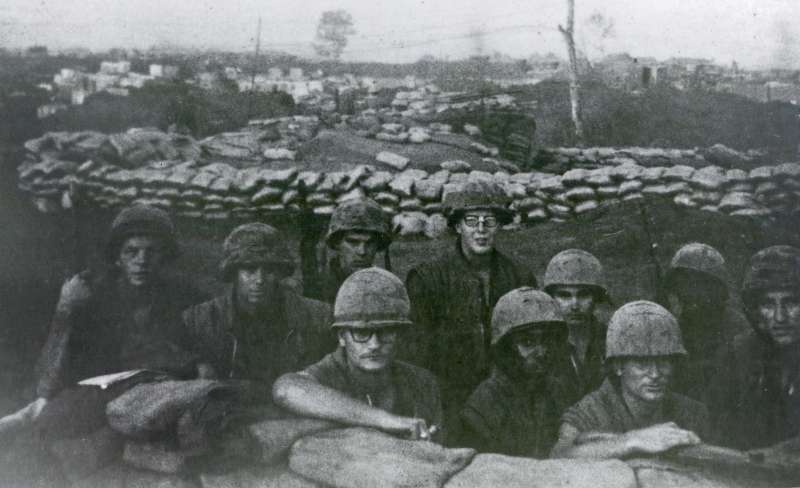
Bravo Company Squad at Khe Sanh Combat Base
Photo courtesy of Mike McCauley

You hear people talk about moments of sublimity, moments when for a short time, they saw into a bigger arena than the day-to-day mishmash of life.

March 30, 1968, was one of those days for me. It was honor and blood and fear and noise and rage and death and brotherhood—maybe even love—that no one who has not been in the fire of combat will understand.

And not just me, but to the men I served with. Here is some of what they told us in the interviews we conducted with them regarding March 30, 1968.

What you will read below is not in any chronological order. The comments from these Marines are in alphabetical order.

Chaotic, of sorts, just as firefights are chaotic.

Cal Bright:

And then, March 30th, we went back out and that was payback time. The Skipper would not allow me to be Point, because he knew I had a score to settle. But he did allow me to be on the left flank. And part of the squad that I was covering for was drawing fire from a couple, three bunkers and somebody told me—I was carrying an M-79  grenade launcher at the time—and they said, “We need some rounds over in this one area.”

And so consequently I used them as a guide, like an aiming stake, and they said I got a hole-in-one because the round went right in the doorway. And it eliminated whatever was in it.

Ken Korkow:

As we went out through our wire, we were getting artillery support in front of us. Boom boom.

I saw the Marine Corps at its best. The Marine Corps is really designed to have peace, but you get peace through strength, you get peace through war.

And I started hauling guys back in. I left my cartridge belt and my .45 behind. I looked like a blooming idiot, you know, and I was a blooming idiot. That’s why old politicians send young kids off to war. Young kids are stupid, they’re invincible. They’re caught up with adrenaline, plus when you don’t care if you’re going to die, you are ready to do crazy things.

All I had in my hand was a K-Bar. Again, that’s really pretty stupid. But the K-Bar was just to rip utilities open, make some tourniquets, stop some bleeding, be able to pull another guy in.

This other guy that I brought in, he’s laying on his back and he’s screaming, “My leg, my leg.”

And when I come up, there’s a hole blown in his flak jacket and a bunch of his guts exposed and I’m thinking his leg must really be screwed up. It was his right leg tucked underneath his back. I pulled his right leg out. Just a piece of shrapnel right on his ankle. I thought, Cowboy, you got no clue, your leg’s not your problem. Got him drug on back to a bomb crater.

Going out after another guy, running ahead, again, you didn’t have to look for wounded people. We had a bunch. And on the lip of a bomb crater there’s Ben Long and Steve Wiese, and, as I’m running by, Ben hollers at me, “Get down.”

I turned to him this way and I said, “Come out and enjoy the war.”

And right then three shells got me. The closest one was about two foot away; the furthest one was about 8 foot away. There was one in between and they were either 60- or 61-millimeter mortar and Ben’s got this ruddy complexion, and I mean it just drained, because he’d just seen one of his good men get blown to bits in front of him and he just got this horrified look on his face. It’s drained.

Ben comes out and he says, “We’ll get you back, you’ll be okay,” and I said, “Don’t worry about me, go get that other guy.”

Well, my helmet’s been blown off, I’ve got shrapnel here under the eye, both arms are totally useless, ah, this leg’s got a big hole in it. I’m telling you, I could not have taken another step.

Ben Long:

When the light started coming, it was foggy. And I thought, whoa, this is good. I really think God is with us. Because that covered us from being seen in our advancing on the enemy position and so, we started to advance; we had .50 caliber machine guns that were firing over our heads. We had to go through a little valley.  It wasn’t very deep, but deep enough that we could have cover from the .50 calibers and then as we approached the trench line, they ceased, and at that point what I remember was the fog lifted. And we could see pretty clearly. And we surprised them.

But, they were still in bunkers and trench lines, and it became hand-to-hand, it became very slow progress because they were a well trained unit. They were North Vietnamese regular army people and had been well trained.

Part of my job was to set up a battalion aid station that went out with us. We took a doctor out with us, and so we had set that up, and immediately people were being wounded and so I was starting to help bring wounded back. Bringing some dead back.

I had a 60-mortar group that was with me. Corporal Korkow was in charge of that and he said, “I’ve shot all my rounds, what do you want me to do?”

And so I started using them to help me to bring dead and wounded back.

Corporal Wiese and I ran into a bomb crater. This bomb crater was over our heads, I mean it was a big bomb crater. And we yelled at Corporal Korkow, “Get down, get down.”

But he didn’t do it. And then about six mortars went off. He was riddled. Because he had a flak vest and diaper on, it didn’t kill him.

I remember one went through his helmet. Blood was just pouring down. So we put on a couple of tourniquets and took him back to the doctor.

I really think Captain Pipes was the one that really made this thing a success. He was cool, he was calm, he knew what he was doing, he was wise in his directing of people.

Even though he was wounded, he was still doing it, still directing, and I remember we were pulling back, and he had given orders to pull back, to come back in. He stood outside the wire until the last man was in. Before he would go in himself. He was just a great leader. And we were very fortunate to have him and for him to be guiding us that day.

Frank McCauley:

March 30th was one of those days where it was just—well, it was the most important day in my life. We got up very early in the morning, probably 4 o’clock in the morning, and were rounded up and we went outside the line.

I can’t believe we made it out through the line, out through the canyon and valleys and came up on that ridge and it was very, very, very foggy.

We broke out of the jungle into a flat, barren, chewed up area of nothing but bomb holes and dirt divots and we saw the end of a trench and a VC come out of the trench and squatted just outside the trench line and took a shit.

Someone said, “Let me get him…shoot him.”

This guy with an M-16 shot him, pow, and he was down.

We had this one guy charging at us. He was probably a hundred feet, maybe a tiny bit farther away, but he was coming right at us, for what reason I don’t know, he didn’t even have a weapon and one of the guys said, “Let me get him, let me get him,” and I’m just there…

I’m a Roman Catholic and I do not wish to take anyone’s life and so I was kind of hoping I could get through this experience without ever using my weapon. I was good with that.

Anyway, this guy took a .45 and he aimed and he shot and he was right beside me and that guy, full bore running at us, folded like a cheap pocketknife, went back maybe a foot in the air and fell to the ground.

This other guy, just beyond that one that came rushing at us knows suddenly, we’re there. So, he is running full bore away from us, and there’s a guy with a LAAW, one of those light armored, ah…like a bazooka. He says, “Let me get him.”

This is so strange because we’re all young idiots and I hadn’t ever killed anyone and I had never fired my weapon except at a range, so I really didn’t wish to play this game, but everyone was really excited about doing this.

The whole weird part was it’s a running human being away from us, and this guy takes this LAAW—It was perfect. That round goes off and you can watch it go through the air and it hit him dead center.  And it just blew up and it was like you could see right through him, schwee, pure light, and he was down.

See, I just wasn’t raised that way, and I didn’t want to participate, and I was really amazed that there were so many people that were greedily trying to kill someone out there. But I guess that’s a good reason because they were actually trying to kill us, too, but I hadn’t come to that realization yet. I just saw us killing them, I hadn’t seen them kill us yet.

I got down behind this tree because I’d already seen a few dead people and I started to get worried that, you know, maybe, gosh, this is not just quite a game, and I peeked up to find out where everyone else was and bark just flew up in my face and I noticed a person beyond and they weren’t fifty feet away and they had dropped down and so I plinked a couple of rounds and I could get down, and we did that two or three times and then I realized this was pop goes the weasel and so I quickly got up there, out of rhythm, and when he came up I just squeezed and shot and the oddest thing, my instructor from the range in Camp Pendleton was there explaining to me about breathing and squeezing.

I took my first shot—right in the head, right in the forehead.

I had just done something I really didn’t wish to do and twenty feet away, is another pop goes the weasel but he’s shooting at my guys over here. He’s only twenty feet away and he keeps popping up and shooting. I didn’t want to think too much about it; for one thing he’s shooting live ammo at my people, so I just took aim and waited and as he did it, I played the game again where I just squeezed and shot. I hit him dead, right through the temple and he was gone.

I’m sitting there going, this ain’t good. I was supposed to be with others so I kind of moved and rolled away and went down into this giant crater that was left by some big B-52 bomb that was about ten feet deep and probably twenty feet across and a little puddle of water at the bottom and I’m sitting there, crouched on the edge of the bowl.

It scared the shit out of me because when I first rolled into there, I could see some green uniforms and then I thought, oh shit, and then I realized that they were American uniforms but they were three  dead Americans laying there sprewed across the sides of the ditch.

Then all of a sudden something catches my eye and this guy comes charging in—one of our guys—and he gets down and his head’s just about ground level and then he goes woooom and whips back, his helmet flies and he falls right at my feet and his brain goes across the dirt and I’m sitting there on the side of this hill looking at this guy and he’s like a gold fish, his eyes are bulging like a Chihuahua.

And then all of a sudden somebody else comes down and it’s a guy who’s been shot and so he’s sitting over there and then another guy comes in that’s a Corpsman and I tell the Corpsman, “You gotta help this guy,” and he comes quickly over and he starts to push the brain back into the skull, and he goes, “I can’t do anything for this guy,” and he quickly goes over to the guy who had his arm shot.

So I’m sitting there in this hole watching a Corpsman work on somebody, and a guy who’s gulping at me, and three dead along the edge, and I go, this ain’t the hole I need to be in. So I quickly crawled out and the incoming was coming like crazy, mortars, and so I saw a small hole, someplace to save my ass, so I haul butt and I jumped with my rifle in my hand, and as I was getting through the air I suddenly realized—and you can’t stop because you’re…you’re in the air heading for this hole–that it’s occupied. It’s got dead people in it, which I didn’t know until after I did a pushup in the air and did not go down on him.

I’m face to face with a guy who’s been dead for quite a while, and he had very little skin on his face. On his skull, it’s just parchment, skin peeled like a creek bottom that’s been dried out, and he’s got maggots coming out of his eye sockets but no eyes, and coming out of his nose and then below him is another guy in the same shape. These are two decayed, bad-news bodies. but they’re not ours, they are Vietnamese.

I finally met up with my machine gun guy—I was supposed to be the A-Gunner to him—and came into a hole, and this other tall Corporal came in and he decides that the reason everyone else around us is dying is because there’s a machine gun nest over there and it’s like a 150 feet away and it’s nothing but more than a big sandbag with a tiny slit in it and they’re ripping on us, and so he says, “Come on, it’s our job, we got to knock it out.”

I’ve seen enough war movies to realize the first wave on a machine gun nest doesn’t make it. He goes, “Come on, let’s go,” and he actually tried to drag me and the machine gunner out of that hole and head for that spot, and I hadn’t even seen it yet.

I go, “Wait, wait, wait, wait.”

Okay, we will do it because that’s kind of what we are supposed to be doing. But I wanted to just see what we were doing, I mean, once I left the bomb hole I really would love to find out where we were going. I don’t want to go out of that hole blind. So I took a peek and I could see the sandbag, and I could see where it was at and I said, “Okay.”

I put a new clip in and I looked at the dirt in front of me and I thought, that’s cool, that’s the last thing I’m going to see because I’m going to fall right face down in that shit when I leave this hole.

So, we charged out of there, all three of us, and I was in the middle, and the machine gunner was here, and the knucklehead was here and a third of the way there, he spun, got hit and left us.

I put every round, all twenty rounds dead center through that little teeny weeny slit and the machine gunner was chewing up those sand bags and we made it, we made it, and jumped over the sandbags and there’s this big pit and two dead gooks and of course the guy with the machine gun, his adrenaline is flowing, but he just blasts them anyway.

I got hit in the leg with shrapnel. A bomb, a mortar, went off right next to my leg and it violently rolled me over. I lost my helmet, lost my rifle.

I laid there in shock because I could feel my leg was burning but I couldn’t feel anything below the burn. All I could feel was cool wet which actually is kind of weird for blood.

I look down and my boot and leg—everything was still there and I’m thinking, well it’s got to be separated, so I wiggled my toes and my toes wiggled back in my boot and I went, ah, shit, it felt like my boot was filling up and overflowing with blood but I still had a leg.

I worked my way down and into a trench and headed toward where we had come in, and lo and behold, the steps that leave the trench where we first shot that guy taking his morning dump, there’s the guy that led the charge against the machine gun nest and he is half passing out and he clutches me. He’s clutching me. He’s going, “Help me, help me.”

And I’m thinking, ah, man, my leg, I can’t.

There’s a Marine crawling next to us, headed towards the rear, and he’s wounded and then suddenly I see this guy coming, and boom, he whips his head, helmet splits, and he’s got no chin. He grabs his chin–all he’s got are upper teeth and a big giant tear in his neck–and he grips it and throws his rifle down and spins and starts running back, but no, in just a matter of two steps he stopped and grabbed the guy on the ground and they both hobbled away toward the rear and I’m thinking shit, if a guy with no chin can help somebody, then with my little dumb leg I can probably do it.

So I say, “Okay,” and I got him in a fireman’s carry and we walked out. I’m gimping and then suddenly automatic machine gun fire opened up on us and he takes a round, I can feel when it hit. He moves on my body and I went holy shit and I went like as fast as—I was flying, I don’t think I even touched ground much, but I hauled ass with him on my back.

I saw a hole and I just chucked him and fell in on top of him. And unfortunately, on that run his arm, which had already been wounded, got hit again and the arm was gone.

It was one of those days. Definitely one of those days.  Anyway, that was my experience with my first kill, and to see people die, and you don’t want your children to experience that.

That’s why I don’t believe in war anymore.

Mike McCauley:

I said, “Ah, oh man, fix bayonets?” At this time, I’m saying this is the real deal and I told the rest of the guys, “Fix bayonets,” and I could see on their faces what it must have looked on me because this is not good. Fix bayonets.

It was almost like popcorn being made, where you heard pop…pop…pop…pop, pop, pop, and then guns started opening  up everywhere, automatic weapons, a lot of small arms, and then we hit the trenches and all hell broke loose, and ah, flames were going off, LAAWS were being shot, rifles,

I jumped into a trench. There was an NVA soldier, he didn’t know what the hell was going on, as much as we did, and I shot him, and I remember his eyes and I remember him going down.

Minutes were hours, hours were seconds, I don’t know how—I don’t even remember how—everything slowed down and speeded up and it was just crazy.

Michael O’Hara:

5 o’clock in the morning always comes too quickly, especially when you are doing something like this. It’s pitch black. Foggy. You couldn’t see.

There were three platoons. Our platoon, Second Platoon, went out of the wire first, ahead of the company and we set up a point where the rest of the company could come and pass through us.

Everything’s cool, nothing’s going on yet, and then the first and the third platoon came out and swept through our position.

First and Third Platoon were the ones that went into the jaws of the tiger first. They went through holy hell. And they paid a terrible price for it.

The order came back to fix bayonets. And that’s when everybody knew this deal was on. It was now.

And we had a ringside seat to it all. And there is really no way to explain what was going on there. I mean, it was flame throwers, it was rockets. Eddie Pendergras, he’s running around with 60 mortars, just sticking it on the ground and dropping into the tube and just pooomp, doing it by ear, you know, Kentucky windage, and they are shooting machine guns at this kid and he’s just dropping them all over the place.

We started setting up in squad rushes and when it was time for my squad to go, Jake says, “Let’s go,” and so we all went forward, and for just a minute we all broke discipline. Once he said, “Go,” we all just took off—and he like to never got us stopped—so we could provide the cover fire we were supposed to.

When I got in those trenches, First and Third Platoon had killed so many of them people that there were just bodies everywhere. I don’t think my foot ever touched the ground. And I was in that trench, I know, for over an hour.

The next moment, the next minute, the next hour it was just—well I will carry it with me the rest of my life.

It was just bodies to your kneecaps in there.

I don’t know if it was Captain Pipes, or who it was said, “Pick that Marine up and take him back.” And I bent down and picked him up and it was Hank Norman.

And everybody just loved him, he was just a great guy. He was just a hell of a nice guy and when I saw who it was, I just—it was just a real ass-kicker, just represented all the heartache of Bravo Company right there, all the names, right there in the bucket, all of them, and I picked him up and put him over my shoulder.

And Kenny Pipes was standing there and I thought to myself, my god, he was blood from one end to the other, I mean he was soaked in it. I thought he’d been hit by machine gun fire, but the guy was standing up, and he had been wounded severely in his armpit and he’d been shot right in the head with a rifle, although it didn’t penetrate his helmet liner, it just hit his helmet. And he had two radios and he was talking to the air on one radio, and he was talking to the artillery on the other radio. And here, all his best friends are laying right here dead at his feet and this guy’s still taking care of business, you know, he’s not losing it, he’s not passing out, he’s taking care of business, and we’ve got bodies laying everywhere.

And then I took Lieutenant Norman and I carried him back. I don’t know how far it was, but I will always remember he weighed so much, he was so heavy my legs ached so bad. And I just kept telling myself, don’t you dare drop him, whatever you do, don’t drop him. And I got back to the APC and there’s just bodies stacked in the damned back, and I laid him down just as gently as I could, and then we began cleaning the mess up.

You just…you just don’t know what it’s like to see a 19 year old kid—I believe it was Rash, but I’m not sure—I think it was Rash, laid out on his belly in the mud, sticking his rifle that direction, gives you the thumbs up and tells you to go that [the opposite] direction, and he knows damned good and well he’s never going to get up out of that mud. He knows he‘s dying for you. And people just cannot understand that.

I have something that most people in the rest of the world will never own, no matter how wealthy they become, or how smart they are, or what they know, but for a little bitty space in time, I was allowed the distinct privilege and the high honor of walking across hallowed ground with the bravest Marines that have ever worn the uniform and it was my privilege. And I will honor their memory until I take my last breath.

Ken Pipes—Company Commander of Bravo:

There was a building anger and a building desire to get outside the wire and to kill as many of them sons-o’-bitches as we could kill.

It was looking the tiger in the eye and riding the elephant.  And I think we carried away from that a lot of things, but the tiger blinked and the elephant knew we could ride him. And we did.

Was it a payback? Was it a payback? I don’t think so. Because the price that we paid then and before, you can’t put a price on. It can’t be bought. I think we proved that retribution was made. And I saw and was part of some of the bravest things I’ve ever seen.

To see the men of Bravo Company moving out with fixed bayonets and going through those trenches, almost fearlessly, was one of the most amazing things I have ever been a part of in my whole life.

And it just signifies and exemplifies what a fine group of Marines that we were fortunate to be a part of.

My God, what men.

Tom Quigley:

Captain Pipes gave me an order to fix bayonets, and at that time it seemed like, all of a sudden, reality sunk into me. I mean, I don’t know what I thought I was doing out there. I mean, this wasn’t a sunny picnic, but it didn’t really hit me that this was going to be a major encounter, a major battle, and my heart just sunk in my throat, you know.

He said, “Call the other platoons and tell them to fix bayonets,” so I got on the radio, and I advised Bravo 1 and Bravo 3, “This is Bravo 6…fix bayonets.”

I had said to the captain when he gave me the order…I said, “Do what?”

And he said, “Be advised to fix bayonets.”

One of the platoon radio operators came back to me and said, “Do what?”

I said, “Be advised to fix bayonets.”

And then I started looking around and I was seeing these Marines taking bayonets out of their backpacks, out of their pants leg, their cartridge belt, wherever they had them, putting them on the end of their rifles and then again, I thought to myself, this is the Real McCoy. It finally hit me, even though I’d been hurt twice earlier, I may not come back from this day.

It seemed like we had just started out, and then a round or two of small arms fire went off and then it just seemed like Charlie all of a sudden realized we were out there. And, once that happened, then all hell broke loose.

Once we started going, there was no walking. All of a sudden, it was an all-out assault. And we started running.

Our command group consisted of the five of us. There was Captain Pipes, his battalion radio operator, Lance Corporal Bragg, I carried the company radio, and then there was Lieutenant Hank Norman who was our artillery forward observer and his radio operator.

The first bomb crater I remember we got in, rounds hit right outside the bomb crater. And the Skipper said, “We got to get the hell out of here, they’ve got us spotted.”

And, then we got into an NVA trench line and at this time the fighting was intense. I mean, there was charging, there was shooting, there was grenade throwing, satchel charges, flame throwers.

Somehow I ended up next to a man with a flame thrower and again, talking like we’re talking here, I asked him, “How long does one of those tanks last of the fire,” and whatever he told me, it wasn’t any time at all—just seconds, and I said to  him, “Well that doesn’t seem very long.”

He said, “If you’re on the other end of it, it’s an eternity.”

As we went further into the NVA trench line, I remember Lieutenant Norman behind me. He had seen our senior Corpsman get hit with shrapnel by a mortar and he had started to stand up and say, “Doc’s been hit,” and when he did, I was crouched in the trench line. I had one hand on my rifle and the other hand on my receiver, and I turned around to hear what he said.

And by that time, several rounds of enemy mortars fell right on top of us, and it took Lieutenant Norman right out. His radio operator was hit, his face kind of busted out bloody, blood running through his fingers. I was hit, Captain Pipes was hit, and his battalion radio operator was also hit.

We were all knocked out, just in a matter of seconds. The rounds came in and knocked every one of us out and then, like I said, unfortunately killed Lieutenant Norman. And I wasn’t more than six feet, seven, eight feet from him. And he took the brunt of the round that I caught shrapnel in my side and my hand had also busted out in blood. I thought I had lost a few fingers but then I found out later it was concussion had forced the blood from out of the pores of my hand.

I could feel the blood start dripping down my back and a Marine from mortars came crawling through the line and I said, “Man, get this radio off my back,” and he unhooked me.

I was able to wiggle out of it. The senior Corpsman, who was also wounded, ended up putting a bandage on me and he probably saved my life because he told me later—we were in the same hospital ward in Japan, Yokosuka—that when I first had asked him how bad it was he said it wasn’t bad at all and then he told me later when I had asked, he said blood was just spurting.

Ken Rodgers:

I’ve got 2 days to go in-country. I really don’t want to be here doing this, fellas, ’cause I’m going home. I’m supposed to go home in two days.

But they didn’t care.

And I had to go because if I didn’t, I couldn’t face my fellow Marines.

Sergeant Alvarado, who was the platoon sergeant, and I ran up through all this mayhem, bodies everywhere, people wounded, and the Skipper, the company commander, was down in a shell hole and there was blood coming out of his ears and his nose and all these guys laying around there dead.

We ran up in front of everybody and Lieutenant Dillon says to me, “Well, mark the spot so they know where you are at.”

I said, “I don’t know what color.”

He said, “It’s a canary!” So I reached and got a yellow smoke grenade and threw it out there and it billowed up, and right then this barrage of artillery—right out in front of us, American  stuff—just flattened everything out there.  And then we just started moving back and picking up the dead Marines.

One of the other platoon commander’s radio man got shot, and by that time we had too many radio men, so they sent me with this guy.

I don’t remember why, but we were going towards the rear and he kept getting out of the North Vietnamese trench and I kept yelling at him to get back in the trench because there were booby traps. I could see these Chinese claymores hanging in the dead trees and he got out of the trench again and was running down the side of the trench and he tripped something and this white phosphorus booby trap came up and hit him and blew off his jaw, if I remember right.

White phosphorus is poison and burns on contact with the air. So his face was burning and I was putting mud on his face. I was really angry at him because I got hit in the face with this stuff. So I was mad at him for not doing what I told him.

I think maybe out of a hundred guys, we had maybe ninety wounded, had quite a few casualties and dead. We killed a bunch of them.

It went on four or five hours like that, up close and personal combat. That was what you joined the Marines for. Be careful what you wish for.  What you join the Marines for is that moment of truth. That was a moment of truth for me and probably for everybody there.

Peter Weiss:

We went on the move and we moved forward fairly smartly, and there was a lot of action going on. At one point I remember I was lying down in a bomb crater, right at the edge, and a grenade came at me, and I mean two feet from me. It’s one of those great stories, there was nobody around to jump on it and be a hero and I just laid there and I started trying to slide away from it, but it never went off and I thought, whoa, now I can move forward. God is with me.

We swept forward, probably went through at least a half dozen bunkers and personally, one guy in front, shooting into the bunkers while a guy went around and dropped grenades into each of these bunkers.

There was corporal whose name was Wayne Moore. His father had been a Marine and he was a tough, tough, kid. And he’s with me and we’re moving forward and he said, “This is the best. When I get out of the Marine Corps, this is what I want to do.” And I thought, are you crazy?

We were right next to each other, he was killed. Boom. He’s dead. Wham.

We moved forward and then we could see NVA soldiers coming from that little village below. We had gone that far, and we knew about where we were supposed to stop. Because Pipes said, “You stop when you see the road.” And we saw the road. So we fired at these guys, and we took a couple of them down.

We retreated and just so happened to find Donald Warren’s body laying about where we had started. And I picked it up and how heavy it is to carry someone who is dead.

Steve Wiese:

Captain Pipes sent the word out on the radio and said, “Fix Bayonets” and that took me totally back. You know, like, fix bayonets? That just brought instant pictures of hand-to-hand combat. I can remember telling the guys in the squad, “Okay, everybody, fix bayonets,” and they were like, “What?

It’s funny now, but it wasn’t then.

We started to sweep in towards that tree line and when that opened, we were kind of pinned down there for a while and there was firing going on back and forth and Wayne Moore jumped up. It was like he’d had enough and he jumped up and charged that machine gun bunker and he was shot several times and didn’t make it, and when he went down, Author Smith jumped up and he charged that bunker and he was shot a couple of times but he made it into the trench line and Author was in the trench line shooting his rifle, going into the machine gun bunker, pulled out his bayonet and the last thing I saw of him was fighting with a bayonet in the bunker.

And he basically took that bunker.

And all of a sudden there was just a big roar, and everybody jumped up and we all started charging the line. And I remember us running toward that line firing. I remember looking over my shoulder and seeing…it was like a ribbon effect. Everybody down that line was just getting up and taking off towards that trench.

These guys, Wayne and Author, were closer than brothers. We had gone through a lot. It was a tough day.

That was a pretty good firefight, that was a pretty good battle going on. It went on for several hours and I got to see some of the most heroic actions anybody could ever witness. To charge a machine gun bunker, that’s a tough thing to swallow.

But I’m glad I’m alive to say it, too, to be a witness to it. So, how I made it out of there, a typical guy, with hard times dealing with the war, is why did I make it out, you know? Why didn’t I get shot that day, when everybody around me was falling, I guess it wasn’t meant to be.

After most of the battle, when we were trying to regroup, Lieutenant Long—he was XO at that time—saw me, and here was a guy that was hit by a mortar, and he was pretty badly wounded, and the lieutenant called me over and needed help. When we picked him up we pulled him back to the rear and I just remember thinking this guy, you know, was almost a waste, I mean why are we trying to drag this guy back?

I just assumed he died and one of my memories of that was this guy, basically a dead man to me, five years ago, I think, I get a phone call. I was coming back from a job and I get a call on my cell phone and he goes, “Do you believe in guys coming back from the dead?”

And I’m like…I say, “What?”

He told me who he was and he goes, “I just remember this blond-haired angel dragging me out.”

That was pretty amazing, to find out this guy had actually survived and was doing well. His name is Ken Korkow, and he ended up getting a Navy Cross that day for his actions.

Sometimes there’s good things that come out, you know. That was one of the good things, to get that phone call.

Somebody actually made it back and survived when you didn’t think he was, you know, alive.

***

Like I said earlier in this blog:

Chaotic

~ By Ken Rodgers

_______________________________

Thank you for reading, and for honoring all Vietnam War veterans by sharing this blog, our films, and stories with friends and other veterans. 

BRAVO! Common Men, Uncommon Valor can be viewed on Amazon Prime. We also have DVDs available, which can be ordered on our website at https://bravotheproject.com.

You can find information about our companion film featuring eleven courageous spouses of combat veterans from various eras at https://imarriedthewar.com. I Married the War can be viewed on Amazon. DVDs are also available via the website.

Documentary Film,Film Screenings,Khe Sanh,Marines,Veterans,Vietnam War

April 8, 2019

News From La Grande, Oregon

Tags: , , , , , , , , , , , , , , , , , , , , , , , , , , , , , , , , , , , , , , , ,

Ten days ago, we were privileged to show BRAVO! in La Grande, Oregon, to an enthusiastic crowd of 150 folks in a jam-packed auditorium at Eastern Oregon University. The event was scheduled as a way to do something special for local Vietnam veterans on March 29 which is National Vietnam War Veterans Day.

Photo of the cake at the La Grande Screening. Photo courtesy of Betty Rodgers

La Grande is located near the home of BRAVO! Marine Ron Rees, whose story is one of the rock ribs of the film. Picturesque snow-capped ranges of mountains surround the valley where La Grande sits near the Grande Ronde River. The valley sported a spring green that shone in the daylight, no matter what time of day. After a long, wet, cold winter it was a pleasure to feel the force of the new season.

The evening began with a chance to feast and visit with Ron and his family, his friends, and numerous local veterans and other folks interested in the film, including Master of Ceremonies Brian Westfield and local Congressman Greg Walden.

After the screening, the audience engaged in a lively panel discussion with Vietnam veterans Ron Rees, Dennis Ross, George Knight and Ken Rodgers about war, veterans and the military.

BRAVO! Marine Ron Rees with his daughters. Photo courtesy of Kim Mead.

Ron made a special request to honor the men who have passed away since the making of BRAVO!. We remembered Marines Ken Pipes, Daniel Horton, Mike McCauley, and Lloyd Scudder, and cinematographer Mark Spear.

Betty and I felt honored to show our film to such a receptive group and to spend time visiting with friends, old and new.

These screening events are the direct result of a group of citizens working together, and this occasion was no exception. Hosting an Oregon premiere of BRAVO! was a dream come true for us, and we thank Ron and his wife Tami Murphy for putting the event together in concert with this impressive list of local sponsors: American Legion Post 43, Auxiliary Post 43, Legacy Ford, Copies Plus, Starbucks (Island City), Safeway, Hines Meat Co., Mission 22, The Landing Hotel, Side A Brewing, Fitzgerald Flowers, Dominos Pizza, and other individuals.

***

BRAVO! is now available in digital form on Amazon Prime.

This link will take you directly to BRAVO!’s Amazon Prime site where you can take a look at the options for streaming: In the US you can stream at https://amzn.to/2Hzf6In.

In the United Kingdom, you can stream at https://www.amazon.co.uk/dp/B07BZKJXBM.

***

If you or your organization would like to host a screening of BRAVO! in your town, please contact us immediately.

***

BRAVO! has a page on Facebook. Please “like” us and “share” the page at https://www.facebook.com/Bravotheproject?ref=hl.

Documentary Film,Eulogies,Khe Sanh,Marines,Other Musings,Veterans,Vietnam War

August 2, 2017

Requiem for a Warrior–Michael H. McCauley

Tags: , , , , , , , , , , , ,

The bonds created by shared fear and the horrors of battle are strong. For years I didn’t understand that. For years I didn’t understand that the bonds forged between warriors who endure the fury of combat even existed. For forty years I felt there really were no such bonds.

Since most Vietnam veterans chose to clamp our mouths shut and corral our memories of combat, the opportunities for us to begin to understand the emotional linkage that exists between warriors were not taken advantage of for decades.

Mike McCauley in Marine Corps dress blues.

I recall the first time I talked to one of my old comrades. It was 25-plus years since I’d escaped the savagery of war, and when we first talked it was like I’d found someone I’d been looking for even though I didn’t know I’d been involved in any such search.

Yet there was something pulling at me and over the intervening years since that initial contact, that attraction, that magnetic force, so to speak, has drawn me into close relationships with the men who shared the nightmares of Khe Sanh with me.

One of those men was Michael H. McCauley. I didn’t know Mike in Vietnam. I might have seen his face as I walked by on my way out on patrol or ambush. We might have nodded at each other and maybe exchanged a comment.

Mike McCauley on a panel of Marines at the screening of BRAVO! in Moscow, Idaho, 2013

He was in First Platoon and I was in Second. He was a relative new guy compared to me. We hadn’t a lot in common . . . me a desert rat from Arizona and he a city boy from Boston. But what we did have in common was the Marine Corps and over seventy days trapped inside the concertina wire perimeter of Khe Sanh Combat Base.

And boy what a bond. We became good friends and I’m not sure that’s even the right word to describe our relationship. We were comrades; we were men who understood what very few could understand. We had knowledge—emotional and intellectual and intuitive—that I really wouldn’t want anybody else to learn because how you learn it, the price of it, is too damned high.

Nevertheless, we were comrades who understood leeches and jungle grass and the roar of 152 millimeter artillery rounds storming at you. We understood the glint in the eye of the enemy, be he living or dead. We understood combat. We could talk about it. And we could laugh about it, among ourselves of course, but not with many of the uninitiated.

Mike liked to hand out these hats to men who served with BRAVO! They were his creations.

And Mike liked to laugh. He was quiet most of the time. A listener with a quick wit. A man who endured much in his life during and after the war.

Mike was a man whom I liked to be around. It was easy being around Mike. No angst, no bullshit, just a straight-up guy. A very kind man beloved by many whether they were war comrades or not.

In the war, Mike saw a lot more hell than I did. He endured the siege and then continued with BRAVO! all spring and summer and fall of 1968 when the 1st Battalion 26th Marines were locked in repetitive battle with the enemy in other locations around South Vietnam.

And like all of us veterans of war fighting, I believe the warrioring took its toll on Mike.

In early July of this year, Mike left us to go wherever it is you go when you pass on. I think he believed that to be some kind of heaven.

Ruth and Mike McCauley in Moscow, Idaho, 2013.

He’d been pretty damned sick for a while. I’d call him up or he’d call me and we’d talk and he’d tell me—he’d man right up—about exactly what was happening to him. It was sad and he was courageous and it hurt me every time we talked and every time I thought about it after switching off the cell phone.

I’m going to miss Mike’s laugh. I’m going to long for his smile and his wry comments in that Boston patois I’d know anywhere.

And yet I’m grateful I can still laugh with him, and recall the Siege of Khe Sanh with him, every time I watch BRAVO!. But not without shedding a tear or two when I think about how much I miss him.
All of us Vietnam veterans are on a march, one from which we can’t fall out, to join Mike and all the other men we served with in that long-ago conflict.

Mike will be interred at Arlington National Cemetery, a place of honor and dignity, on August 7, 2017 at 11:00 AM. Arlington, a place he deserves to rest.

Our deepest condolences to Mike’s devoted wife, Ruth McCauley, his big and boisterous family who embraced Betty and me with open arms, and the multitude of his many beloved friends around the country.

Documentary Film,Khe Sanh,Khe Sanh Veteran's Reunion,Marines,Other Musings,Veterans,Vietnam War

October 5, 2016

Full Circle

Tags: , , , , , , , , , , , , , , , , , , , , , , , , , ,

Next week Betty and I will be journeying to Texas, to the Khe Sanh Veterans Reunion which will be held at San Antonio’s El Rancho Tropicana Hotel.

Just a little over six years ago, we set out from Montreal, Canada, where we were attending the Montreal Jazz Festival with our friends and relatives, Chuck and Donna Dennis, to head out to San Antonio for the 2010 reunion, and to film nine of the interviewees in the film, BRAVO!.

Back then, when we began the journey to tell the story of Bravo Company, 1/26 at the Siege of Khe Sanh, we had little to no knowledge of how to make a film. But, we knew we needed interviews, so undaunted, we marched on and showed up in San Antonio, made arrangements for a space to conduct interviews, picked up our videographer at the airport and proceeded to film the men.

John “Doc” Cicala, Frank McCauley, Mike McCauley, Michael E O’Hara, Ken Pipes, Ron Rees, the late Lloyd Scudder, Peter Weiss and Steve Wiese sat down and talked to me and the crew about their remembrances of the siege and what it meant to them then, in 1968, and what it meant to them in July 2010.

The late Mark Spear at the Khe Sanh Veterans reunion in San Antonio, Texas, July 2010

The late Mark Spear at the Khe Sanh Veterans reunion in San Antonio, Texas, July 2010

I often think of the intestinal fortitude these men demonstrated as they sat down and let their emotions bleed out for all the world to see. I recall sitting there across from them, hearing their stories, marveling at the way they just let it all spill out, and if it wasn’t all, it was certainly enough to wow the folks who would eventually work on and sit down to watch their powerful testimonies about fear, death, loss and ultimately, their victories over the obstacles that their experiences at Khe Sanh threw in front of them. The men were inspiring.

Now, six years later, we are going back to San Antonio and for me, it feels like we are coming full circle. Two of the men in the film, Dan Horton and the aforementioned Lloyd Scudder, are no longer with us as is also the case with videographer Mark Spear, and it makes me very happy that we got the interviews done—in the case of Dan and Lloyd—before these Marines left us.

I am also very grateful that we got to know Mark Spear before he made a way too early journey from those he loved and those of us who appreciated his sensitive, funny, artistic nature.

Some of the men in the film will not be there in San Antonio to sit around and talk about the war and our memories of it and how the film affected our views of that experience. And I wonder, in the case of those who have not said so, if BRAVO! in any way changed their lives, helped or hindered them in their ongoing drive to live on in spite of the mental and physical affects of the combat we faced during the Vietnam War.

The Late Lloyd Scudder at his Bravo! interview.

The Late Lloyd Scudder at his Bravo! interview.

Personally, what can I say about what BRAVO! has done for me? Well, for starters, I can say that I am now hooked on making films.

And I am now immersed in the world of combat veterans and all the accoutrements both good and bad that come with having let oneself become so immersed. Organizations, acquaintances, events, travel—yes, it’s greatly changed the world I personally inhabit.

And I think, in some ways, it’s helped me come to grips with my own horrors, the ones that lurk just behind me as I try to keep the memories of January, February, March and early April 1968 caged in some form of mental box.

It taught me that the men I knew in the trenches at Khe Sanh survived (as did I) second-by-second high grade fear, wounds, loss, and in most cases came out the other end able to deal with all the bad stuff. It taught me that the soul, however one wishes to describe or define it, can be ripped, stripped, battered and stabbed, but in the end, it can still emerge in triumph.

The keenest knowledge I’ve gained is the realization that instead of being alone, I know that there are a multitude of warriors who have experienced what I did—the constant fear that rides you like you were an underfed jackass, the need to be brave even though it may lead to your death, the loss of your friends’ lives. I have siblings, so to speak, who have trod or are now treading the treacherous ground with me.

The late Dan Horton at his Bravo interview at Ann Arbor, MI

The late Dan Horton at his Bravo interview at Ann Arbor, MI

For years, intellectually, I understood that I endured what millions have endured in war, but emotionally, I felt all alone, out there on a limb so to speak where no one could reach me.

Making BRAVO! taught me that there are others, right now, out there with me.

So I’m looking forward to getting to San Antonio and seeing who I know so we can sit around and talk about it all. Maybe we will laugh and maybe we won’t, but it will not matter, because I will not be alone.

If you or your organization would like to host a screening of BRAVO! in your town please contact us immediately.

DVDs of BRAVO! are available. Please consider gifting copies to a veteran, a teacher, a history buff, a library, a friend or family member. For more information, go to https://bravotheproject.com/store/.

BRAVO! has a page on Facebook. Please “like” us and “share” the page at https://www.facebook.com/Bravotheproject?ref=hl.

Documentary Film,Khe Sanh,Marines,Other Musings,Veterans,Veterans Courts,Vietnam War

June 15, 2016

On Veterans Courts

Tags: , , , , , , , , , , , , , , , , , , , , , , , , , , , , , , , , ,

Several weeks back we wrote a blog entry about how BRAVO! has become a part of the training regimen for new Marine officers at The Basic School at Quantico and we were amazed, as filmmakers, how the movie had grown into something we could not have imagined. What began as an attempt to tell a story about a small group of Marines at the Siege of Khe Sanh has since been used, for example, in college film classes, and high school history classes, and several California prisons, and creative writing classes and as part of a symposium on the humanities and the Vietnam War.

To the list of uses, add BRAVO! COMMON MEN, UNCOMMON VALOR as a tool to help veteran court personnel understand the ravages of war and why some veterans might go off the rails, so to speak, and run afoul of the law.

On June 1, 2016, BRAVO! was screened at the 2016 Justice For Vets Convention in Anaheim, California and an interested group of attendees watched the film and then participated in Q & A with the filmmakers. The questions asked were incisive and spoke to the attendees’ interests in veterans, TBI, PTSD, crime and justice.

The folks who came to see the film were judges, attorneys—both prosecuting and defense—court clerks, mentors, psychologists, police personnel, parole and probation officers, court coordinators, and more.

As I attended the conference, the thought came to me: Why do veterans deserve a different court system than everybody else and over the course of a couple of days, I got some answers.

Veterans courts aren’t the only courts that treat offenders differently. There are drug courts, and mental health courts and tribal courts, to name a few. So veterans aren’t the only folks getting special treatment in the justice system.

I heard more than one presenter at the conference explain it this way: Veterans went to serve the country and it is understood that the service was often hazardous. Now they have returned and have had some troubles transitioning into civilian life. Many of them have physical injuries and injuries to the soul and now it is time for us, American society, to serve them in their time of need. Like they did for us. And one of the ways we can serve them is to allow them to go through the veterans’ court program.

Left to right: Michael Jackson, Anne Jackson, Betty Rodgers, Ken Rodgers. Michael is a retired Air Force Colonel and Anne is a prosecutor. The Jacksons share their expertise on veterans, combat and family issues all around the nation. Photo courtesy of Brian L. Meyer.

Left to right: Michael Jackson, Anne Jackson, Betty Rodgers, Ken Rodgers. Michael is a retired Air Force Colonel and Anne is a prosecutor. The Jacksons share their expertise on veterans, combat and family issues all around the nation. Photo courtesy of Brian L. Meyer.

Apparently, the first veteran’s court was established in Buffalo, NY. There are over two hundred veteran court systems in the country now and the trend is growing in local jurisdictions nationwide.

And why? They seem to work. One of the founders of the Buffalo veterans court is Patrick Welch, PhD, a Marine who served as an enlisted man in Vietnam and was awarded a Purple Heart for the wounds he received there. Dr. Welch told a group of us why veterans courts are important, “Because incarceration doesn’t work.”

So, to avoid institutionalizing veterans in the prison system, it is thought to be cheaper and more effective to run offenders through a special court system.

These courts are fairly new and the experience society has had with them has yet to stand the test of passing years, but time after time Betty and I heard that the recidivism—the rate of veterans coming back into the court system after having successfully completed veterans courts—is significantly lower than the old established court system. This is a major win.

We initially became interested in veterans courts here in Idaho where we have six veteran court systems and it appears they are doing a good job of helping veterans who run afoul of the legal system for one reason or another.

Left to right: Dr. Brian L. Meyer, Interim Associate Chief of Mental Health Clinical Services, Supervisory Psychologist, and Substance Abuse/Post-Traumatic Stress Disorder Specialist at the H.H. McGuire Veterans Administration Medical Center and an Assistant Professor in the Department of Psychiatry at Virginia Commonwealth University, Ken Rodgers and Betty Rodgers. Photo courtesy of Anne Jackson.

Left to right: Dr. Brian L. Meyer, Interim Associate Chief of Mental Health Clinical Services, Supervisory Psychologist, and Substance Abuse/Post-Traumatic Stress Disorder Specialist at the H.H. McGuire Veterans Administration Medical Center and an Assistant Professor in the Department of Psychiatry at Virginia Commonwealth University, Ken Rodgers and Betty Rodgers. Photo courtesy of Anne Jackson.

We couldn’t be more pleased to know that BRAVO! has now become a tool to help veterans court professionals and volunteers understand the underlying trauma generated by combat.

And thanks you very much to the National Association of Drug Court Professionals, Justice for Vets, Terrence Walton and his entire staff at the NADCP for inviting us to screen BRAVO!

So, to the men of BRAVO!: Cal Bright, John Cicala, the late Dan Horton, Ken Korkow, Ben Long, Frank McCauley, Mike McCauley, Michael O’Hara, Ken Pipes, Tom Quigley, Ron Rees, the late Lloyd Scudder, Peter Weiss and Steve Wiese, a big oorah! Because in overcoming your reluctance (and fears) that created a barrier to you telling your stories about the Siege of Khe Sanh and all its horrors, you have, besides recording an important piece of history, become educators to the folks who administer our veterans courts.

If you or your organization would like to host a screening of BRAVO! in your town this coming summer, fall, winter or next spring please contact us immediately.

DVDs of BRAVO! are available. Please consider gifting copies to a veteran, a history buff, a library, a friend or family member. For more information, go to https://bravotheproject.com/buy-the-dvd/.

BRAVO! has a page on Facebook. Please “like” us and “share” the page at https://www.facebook.com/Bravotheproject?ref=hl.

Documentary Film,Film Screenings,Khe Sanh,Khe Sanh Veteran's Reunion,Marines,Vietnam War

November 19, 2014

On Sweet Pacific Breezes and Film Screenings, Reunions and Survival

Tags: , , , , , , , , , , , , , , , , , , , , , , , , , , , , , , , , , , , , , , , , , ,

This past week the BRAVO! team spent the week at the Khe Sanh Veterans annual reunion at the Town and Country Resort in San Diego, California.

We met again with men who served with Bravo Company, First Battalion, 26th Marine Regiment before, during and after the Siege of Khe Sanh. We also met new friends and old friends from other outfits and shared stories, memories, tears and laughs.

Every year these events get more intimate and emotional for us. The ties that bind the survivors of any crisis are strong and can only be severed by death. This is very true for the men who served during the Siege. For those of us who endured the horror of that prolonged battle, the bonds of comradeship are stout. As one looks across a room full of veterans of that action, he knows that the people sitting out there, even if he does not personally know them, all understand the lifelong tensions and anxiety that simmer down inside.

One of the most exciting things that happened to us at the 2014 reunion was being joined by our family. Son Jim and his wife Norma, along with their daughters Justyce and Jayden drove over from Casa Grande, Arizona. Daughter Sarah and husband Baruch along with their daughter Isadora came in from Seattle, Washington. We were all present at the reunion banquet when Justyce, who received a scholarship from the Khe Sanh Veterans Association, was recognized by the scholarship committee chair, Dan Fisher.

BRAVO! Corpsmen and Marines: Back (L to R): Jim Beall, Charles McIntire, Tom Quigley, John Cicala, Tom Kupcho, Ken Pipes, Front (L to R): Ken Korkow, Ken Rodgers, Mike McCauley, Ben Long © Betty Rodgers 2014

BRAVO! Corpsmen and Marines: Back (L to R): Jim Beall, Charles McIntire, Tom Quigley, John Cicala, Tom Kupcho, Ken Pipes, Front (L to R): Ken Korkow, Ken Rodgers, Mike McCauley, Ben Long
© Betty Rodgers 2014

Thanks to Tom Eichler, John Pessoni and the rest of the leaders of the Khe Sanh Veterans for all their hard work in putting the event together. Now, next year, on to Savannah, Georgia.

While we were at the reunion, we slipped away to screen BRAVO! COMMON MEN, UNCOMMON VALOR at American Legion Post 291, Newport Beach, California. While the calming Pacific breezes wafted over the sailboats berthed at the pier outside the post, an earnest audience of seventy-plus people saw the film. Among the attendees were BRAVO! Marines Skipper Ken Pipes, Ben Long, Ken Korkow, Mike McCauley, John Cicala and Tom Quigley. Also there were other men who served with Bravo Company, Jim Beall and Charles McIntire. Area residents Ray and Barbara Doyle and Robin Zimmermann who contributed both music and expertise to the film came and visited with us and watched BRAVO!

A big shout-out to Tony Arrigo, Jim Kaylor and Roger Henry who worked hard to make sure the event came off without a hitch.

Something about the contrast between balmy southern California weather outside and the intense representation of the violence, agony and redemption depicted inside during the screening of the film seemed to make the day more poignant.

At the Newport Beach Screening, left to right: Barbara Doyle, Ray Doyle and Robin Zimmermann. © Betty Rodgers 2014

At the Newport Beach Screening, left to right: Barbara Doyle, Ray Doyle and Robin Zimmermann.
© Betty Rodgers 2014

Aside from the Khe Sanh Veterans reunion and the Newport Beach screening, BRAVO! was featured in an outstanding news feature by reporter Matt Burke in The Stars and Stripes which serves the United States’ military community worldwide. You can read the article here.
http://www.stripes.com/news/special-reports/vietnam-at-50/the-bloody-battle-of-khe-sanh-77-days-under-siege-1.314627

Up next for the BRAVO! team, back to Idaho for a battery recharge and plans for screenings in March 2015 to coincide with the first year of the 50th anniversary of the Vietnam War and for Welcome Home Vietnam Veterans Day.

If you or your organization would like to host a screening of BRAVO! in your town this winter or spring, please contact us immediately.

DVDs of BRAVO! are available. For more information, go to https://bravotheproject.com/buy-the-dvd/.

BRAVO! has a page on Facebook. Please “like” us and “share” the page at https://www.facebook.com/Bravotheproject/. It’s another way to stay up on our news and help raise more public awareness of this film.

Documentary Film,Khe Sanh,Marines,Meet the Men,Other Musings,Vietnam War

May 21, 2014

Anatomy of a Photograph

Tags: , , , , , , , , , , , , , , , , , , ,

One of the seminal images associated with BRAVO! COMMON MEN, UNCOMMON VALOR is a photo provided to us by BRAVO! Marine Mike McCauley. When we interviewed nine of the men in San Antonio in July 2010, Mike brought a copy of the image presented below and we knew immediately that it would be an important addition to the film. The men in this photo were in Third Squad, First Platoon of Bravo Company, 1/26.

3rd Squad, 1st Platoon, Bravo, 1/26. Photo by Author Smith Photo Courtesy of Mike McCauley

3rd Squad, 1st Platoon, Bravo, 1/26.
Photo by Author Smith
Photo Courtesy of Mike McCauley

One of the major desires we had as filmmakers was to make sure that as many of the images and sounds as possible were generated during the actual time of the battle. This includes photos, film, video, and oral interviews, so having a photo like this, taken of men who were actually in Bravo Company in that time and place was very important to us. Not only were we interested in the photo being genuine, we were interested in the aesthetic value the picture holds. I say holds because there is something organic to this particular image that captures the sadness, the sorrow, the horror, the stoic courage and the brotherhood experienced by the men who fought at the Siege of Khe Sanh.

The Marines in the photo are listed below. Please note that in the Marine Corps in the 1960s, you rarely called anyone by their first name. You probably didn’t know their first name. In regards to the “unknown” there were so many men who came and went as replacements-in and casualties-or-deaths-out, that you often didn’t have time to know their names. You may not have wanted to know their names, because that meant you would have to get to know them and you did not want to get to know them because if they were killed you had to deal with the personal grief that ensued as a result of their deaths. Please also note that some of the names may not be spelled correctly since we are relying on memories of over forty years.

Back row, left to right:

Black, Paben, Shockley, Unknown

Front row, left to right:

McCauley (Mike, from the film), Britt (Ted), Sinkowietz, Beamon, Roper and Wiese (Steve). Steve Wiese was the squad leader of 3rd Squad and is also one of the men featured in the film.

According to Mike McCauley, this photo was taken by Author Smith who was killed in action in what has come to be called the Payback Patrol which occurred on March 30, 1968. According to Steve Wiese, Author Smith was KIA while overwhelming a NVA machine gun bunker. You can read more about Author Smith here: http://www.virtualwall.org/ds/SmithAC03a.htm.

Mike McCauley

Mike McCauley

Of the other men in this photo, Ted Britt was also KIA on March 30. He was posthumously awarded a Silver Star for his actions on that date. According to Ted Britt’s Silver Star citation:

While reorganizing to continue the attack, his squad was suddenly pinned down by hostile mortar and machine gun fire. Realizing the seriousness of the situation, Private First Class Britt alertly pinpointed the primary source of fire and unhesitatingly left his covered position to assault the automatic weapons emplacement. Fearlessly moving across the fire-swept terrain, he reached the fortified bunker and, delivering a heavy volume of accurate fire, killed four enemy soldiers and silenced the hostile fire. Continuing his determined efforts, he launched another attack against an enemy fighting hole, and while boldly advancing, he was fatally wounded.

You can read Ted Britt’s entire Silver Star citation here: http://projects.militarytimes.com/citations-medals-awards/recipient.php?recipientid=23309.

Photography is a way for us to record the present so folks can understand what was happening at a given moment. Photography is journalism but it is also art that allows us to acquire the visceral, personal knowledge that can’t always be given us in words. We feel the moment, the subject, the place.

Steve Wiese

Steve Wiese

This photo of the men in Third Squad, First Platoon, Bravo 1/26 gives us a peek at the time and the place and the sadness, again, of the Marines of Khe Sanh. That peek is related to the aesthetic power photography holds. The image is in black and white and captures the mood of the men at the siege. Somehow, that array of grays and blacks and whites reveals messages to us.

The faces in this photo are gaunt and mildly disturbed. The men you see are young, none of them over twenty years old. Fear has aged them. They are not happy yet they seem determined. They are a team, a brotherhood, and they are not creations for a Hollywood film. Some of them are not coming home and they may know that. Some of them were probably wounded soon after this photo was taken. Some of them were killed later at Khe Sanh, as well as after Bravo 1/26 moved south. Some of them are probably trying, right now, to forget what happened to them and their comrades at Khe Sanh.

And some of us remember and feel we have…and I emphasize the “have”…to tell the story of what happened at Khe Sanh, to the men of BRAVO!, to all women and men in all wars, and this photo, with its real men, its real heroes, plays a critical role in helping us create the narrative.

DVDs of BRAVO! are available. For more information about purchasing BRAVO! DVDs, go to https://bravotheproject.com/buy-the-dvd/.

BRAVO! has a page on Facebook. Please “like” us and “share” the page at https://www.facebook.com/Bravotheproject/. It’s another way we can spread the word about the film and the Vietnam War.

Documentary Film,Khe Sanh,Marines,Other

January 14, 2014

Kudos to BRAVO! Supporter Mike Shipman for Creating BRAVO!’s Cover Art

Tags: , , , , , , , , , , , , , , , , , , , , , , , ,

BRAVO!’s Cover Art

Ever wonder about the person and story behind the art? We have been so pleased with the reaction to BRAVO!’s graphic design that we’d like to tell you more about its genesis.

Early on, we realized the message conveyed by our posters, DVD cover, and other items should be created by a professional. We knew we had exceptional elements, but didn’t quite know how to put them together in a way that would impart the heart and soul of these Bravo Company men and their story.

BRAVO! Graphic Image by Mike Shipman © Kingfisher Arts, LLC 2013

It started with Betty and BRAVO! friend Sheila Robertson visiting the Boise indie theater, The Flicks, and meeting with owner Carole Skinner. Carole took the time to show us many of the posters she keeps on hand, from the old classics to present-day films. From that experience, we knew we preferred a deep, rich, blue background. Sheila suggested using the Marine Corps dress blues…perfect!

We also knew we had a one-of-a-kind photo, provided by Mike McCauley. The faces you see are Steve Wiese’s actual Bravo Company squad. Steve Wiese is on the far right, and Mike McCauley on the far left. Both Steve and Mike are in the film; some of the other fellows, a few of whom are mentioned in BRAVO!, were killed at Khe Sanh.

With concept and photo in mind, we then turned to our friend and Idaho photographer Mike Shipman, http://www.mikeshipman.com/#!/index. Mike took our ideas and added his own to produce the final piece. He photographed Gary Sullivan’s Marine Corps dress blues to use as the background, and Ken’s Purple Heart medal and Vietnam service ribbon for the other elements in the composition. Mike photographed Gary Sullivan in his dress blues at Gary’s place of business, Quinn’s Restaurant and Lounge in Boise. (Quinn’s is well known for its lively USMC Birthday Party every year on November 10.) The other elements were photographed and composited at Mike’s home studio in Nampa, Idaho.

Monique and Mike Shipman © Betty Rodgers 2013

We couldn’t have been more pleased with the end result. Once again, as has happened since the beginning, we put a collaborative effort into the hands of a true professional, and it paid off.

A full-time photographer with a degree in wildlife biology, Mike Shipman has made a big impact in the photography world here in Idaho and beyond. His work is commissioned by a fascinating variety of businesses, he travels around the globe to places like Zanzibar and Uruguay to photograph and experience the culture, and he teaches workshops around the U.S. from Maine to San Francisco and locally here in the Boise area. He lists his workshop services at http://www.blueplanetphoto.com/#axzz2qKfGp5g4.

Ken and Betty participated in a special workshop with Mike this last May. We traipsed up to the south fork of the Payette River and learned about long exposures. Standing alongside the flowing river, Mike taught us to relax, to settle into the environment and begin looking at detail. “What subject draws your eye? What is it about the subject that draws your eye? What detail can you single out to photograph?” We began to see the way the water slipped around and over individual rocks and boulders, we saw how the color changed, and we saw textures and patterns. Then Mike taught us about composition and balancing “film” speed, shutter speed and lens openings to capture what we observed and felt. It was a remarkable day.

Mike is also an accomplished writer, as you will note on his website and newsletter. We were honored to feature his Bravo! blog in 2012 at this link: https://bravotheproject.com/2012/05/07/bravo-2/.

We were fortunate to meet Mike when we first moved to Boise, and have benefitted from his teaching, mentoring, and friendship ever since. We are very proud that he is a significant player in the BRAVO! you see today.

DVDs of BRAVO! are now for sale with a limited-time special offer at http://bit.ly/18Pgxe5.

BRAVO! has a page on Facebook. Please “like” us and “share” the page at https://www.facebook.com/Bravotheproject/. It’s another way we can spread the word.

Documentary Film,Film Screenings,Khe Sanh,Marines,Vietnam War

April 25, 2013

News From the Moscow Screening and What’s Up Next

Tags: , , , , , , , , , , , , , , , , , , , , , , , , , , , , , , , , , , , , , , , , , , , , , , , , , ,

The screening of BRAVO! to nearly two hundred attendees last week in Moscow, Idaho, co-sponsored by the University of Idaho’s Operation Education and the Department of English, was an amazing experience for co-producers Betty and Ken Rodgers. We were enthusiastically received and got to taste the flavor of campus life at the University of Idaho.

BRAVO! on the marquee

We were received on Wednesday evening by our hostess, journalist and author Julie Titone. Julie, along with her former husband, the recently-deceased Grady Myers, co-authored a book about Vietnam titled Boo-Coo Dinky Dow, My Short Crazy Vietnam War. You can find out more about the book here.

Thursday morning, Betty and Ken met with Ed McBride of Operation Education and talked about the upcoming events in which they were to participate, followed by a stimulating session with Dr. Anna Banks’ documentary film class where we showed clips of BRAVO! and had a great discussion with the students.

For lunch, Betty and I enjoyed the succulent Sublamb gyros from Mikey’s Greek Gyros on Main Street in Moscow.

From there, we met with Laura Pizzo of the English Department for a Q & A session with students of the university. We talked about art, writing and how to simultaneously maintain both a non-writing career and a writing practice.

After that we met with Christine Cavanaugh at the beautifully restored Kenworthy Performing Arts Centre to make sure that BRAVO! would look and sound just right for the following evening’s audience.

We finished up the evening with elegant pizzas—yes, elegant—from Maialina Pizzeria Napoletana just down Main Street from the Kenworthy.

Those Pizzas

Friday, April 19, we enjoyed lunch with Ed McBride, Dan Button, and members of Operation Education’s advisory council. We also met five disabled veterans of this country’s current conflicts, and it was inspiring to hear these young people talk about how they are overcoming the difficulties they endure as a result of their service in combat zones. Among the tools they use to move forward in life are the educational opportunities afforded by Operation Education and the University of Idaho.

Betty and I then met with a small crowd of listeners at Moscow’s independent bookseller, BookPeople, where we had a discussion about turning the pain of war, the pain of life, into art. Ken read selected poems from his books of poetry.

Mark Spear, principle videographer for BRAVO! and BRAVO! Marines Ron Rees and Mike McCauley joined us for the screening that began at 6:30 PM with an introduction by Dr. Brett Morris, retired Colonel in the United States Air Force and current Director of Internal Strategic Communication at the university. First off was the presentation of the colors by the color guard from the Joint University of Idaho-Washington State University ROTC programs.

This was followed by an a capella singing of the National Anthem by University of Idaho MFA candidate in Creative Writing, Sarah B. Barrett, whose father served in Vietnam.

Moscow’s Mayor Nancy Chaney welcomed both the audience and the filmmakers to the community, and was followed by University Vice-President of Advancement, Chris Murray, who welcomed the attendees on behalf of the University and Operation Education.

Filmmakers Ken and Betty Rodgers then talked briefly about the film.

After the screening, members of the film’s audience and a panel moderated by Dr. Morris discussed war in its many aspects, past, present and future. The panel talked about war and film, war and memory, war and guilt, war and PTSD. Members of the panel (all Marines with combat experience) included Latah County Magistrate William Hamlett, Retired Marine Corps Colonel Bob Wakefield, Mr. Paul Warmbier who is a teacher in the Moscow school system and Marine veteran of the battle of Fallujah in Iraq, and BRAVO! Marines Mike McCauley and Ken Rodgers.

Many thanks to Kim Barnes, Professor of English at the University of Idaho, for her vision, drive and attention to detail that made this screening and its related activities possible and successful. Thanks, too, to others who helped make the BRAVO! screening a success, including UI’s Karen Hunt, Kate Cobb, Max Eberts, Kelly Roberts and Laura Zak, as well as Jennifer Bauer of the Lewiston Tribune/Moscow-Pullman Daily News.

The day after the events at Moscow, Ken and Betty took a needed day off and toured the country–the magnificent Palouse including views from Steptoe Butte, multiple teams of draft animals plowing and harrowing west of Colfax and a visit to thunderous Palouse Falls.

Draft horses on the Palouse

Next up for BRAVO! are two screenings in Sonora, California, at Columbia College on May 18 (Armed Forces Day), 2013. This screening is sponsored by Vietnam Veterans of America Chapter 391, Columbia College, and Mike Preston who is a veteran of the Siege of Khe Sanh and a lifetime member of the Khe Sanh Veterans. More details on the Sonora screening at http://www.vietnamveterans391.org/.

Documentary Film,Film Reviews,Khe Sanh,Marines,Vietnam War

April 9, 2013

News About Screenings in Moscow, Idaho and Sonora, California

Tags: , , , , , , , , , , , , , , , , , , , , , , , , , , ,

MOSCOW, Idaho

Here’s the info on the screening of BRAVO!, COMMON MEN, UNCOMMON VALOR in Moscow, Idaho, on April 19, 2013 at 6:30 PM. Screening is at The Kenworthy Performing Arts Centre at 508 South Main Street, in Moscow. Doors open at 6:00 PM. There will be a panel discussion on aspects of and the nature of war across generations and conflicts. At the screening you will be able to meet the filmmakers, Ken and Betty Rodgers, the film’s principal videographer, Mark Spear, as well as Mike McCauley and Ron Rees, Bravo Company Marines who are in the film.

This screening of BRAVO! is sponsored by the University of Idaho’s Operation Education and English Department, and is free of charge but donations to Operation Education are strongly encouraged. Operation Education assists disabled combat veterans in attaining a college degree. You can find out more about Operation Education at http://www.uidaho.edu/operationeducation.

Thank you to the Kenworthy Performing Arts Centre (http://www.kenworthy.org/index.html), Ed McBride and Dan Button of Operation Education, and Kim Barnes and Laura Pizzo from University of Idaho’s Department of English, and Julie Titone for making this screening possible.

SONORA, California

On May 18 (Armed Forces Day), 2013, BRAVO! will be screened in Sonora, California. Below is the notice about the screening and the film from Khe Sanh brother Mike Preston, who is mainly responsible for the screening:

Here is a 2 hour first run movie like you will never see anywhere else, not at any theater, it is shown only privately. This film was made by Ken Rodgers (and his wife Betty), who lived the whole experience with Bravo Co, 1st Battalion, 26th Marines. This is about the 77 day siege of Khe Sanh starting 21 January 1968; the Tet Offensive. It also covers the ill fated “Ghost Patrol” of 25 February and subsequent action in retaliation such as ”The Payback” battle on 30 March which was the only Marine Corps bayonet charge in Vietnam history and the only one since World War 2.

Less than 100 men participated and 19 were KIA . There were over 100 Purple Hearts earned that day, some men having multiple wounds . Other awards were 2 Navy Crosses, 8 Silver Stars , 9 Bronze Stars with “V”, 2 Navy Commendations w/V. One hell of a heroic day!

There are 15 Marines interviewed who are participants in the film itself. These guys are the “been there done that” gang, common men, uncommon valor. This film has a lot of historical significance, being about the longest and biggest battle of the 10 year conflict.

Seating is limited to 400 tickets max. Tickets are $10.00 and are available on line at Vietnam Veterans of America #391 for each of the two showings at 5:00 PM and 8:00 PM at Columbia College. There are also 3 trailers to see from the Bravo website. Just click below. If tickets are sold out and if you show up at the door at show time and there are any no-shows, you will be seated. All email tickets will be ”will-call” at the door. Tickets will also be available at Columbia College: Call Michelle Vidaurri at 588-1505. In Calaveras County, contact Bravo Project chairman Mike Preston @ 795-1864. Tuolumne County, contact Carol Southern at 938-3848.

Please send this to all who may be interested.

Thank you,
Mike Preston

Vietnam Veterans of America #391